Concentrated Stock & Equity Compensation Planning
The stock that built your wealth might not be the one that protects it.
Maybe it came from an IPO, equity compensation, or simply choosing the right investment years ago. However it happened, a concentrated stock position is now an outsized part of your balance sheet. It’s a remarkable opportunity.
You need a plan that addresses this position and, where it makes sense, helps you diversify, ideally without handing a large share of the gain to taxes. The earlier you plan, the more options you keep.
Hold forever or sell and pay taxes. What if there's another path?
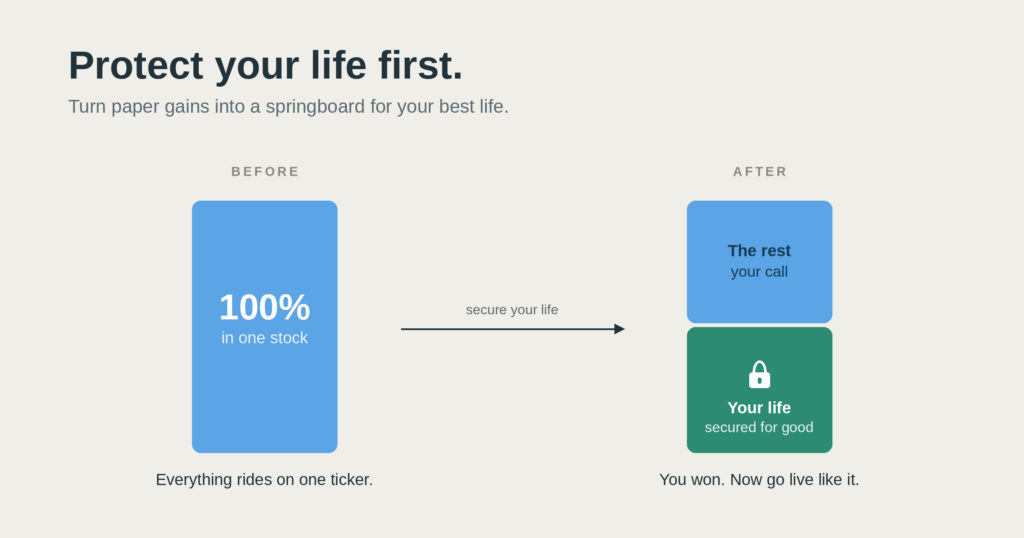
Most people hold their concentrated stock position because selling feels like a penalty for being right. The CURRENTS approach treats a potential tax bill as a variable to manage. You have options, some simple, some complex. Finding the right way out is exactly what we do.
From one position to a full strategy.
Your PositionThe Toolkit
Staged Liquidation
Selling systematically across multiple tax years, against a capital gains budget you set. You stay in control of the timing.
Options Overlays
Protecting the downside of a position you still hold, and in some cases generating income while you plan the exit.
Exchange Funds
Diversifying a large position without triggering a sale, by pooling it with other concentrated holders.
Direct Indexing + Tax-Loss Harvesting
A portfolio built to systematically generate losses that offset your gains as you unwind the position.
Long/Short Overlays
For larger positions that need a more aggressive exit path, hedging exposure while the unwind runs.
Equity Comp Planning
Exercise timing, vesting schedules, and AMT exposure, coordinated so your compensation doesn't deepen the concentration.
Charitable Giving Strategies
Donor-advised funds and charitable trusts that turn appreciated shares into impact, eliminating or deferring the gain on what you give.
Gifting & Estate Integration
Moving appreciated shares to family or trusts as part of the exit, so the position serves the people it was built for.
Securities-Based Lending
Accessing liquidity from the position without selling it, useful as a bridge while the longer exit plan runs.
For information only, not advice, and not a complete list of the strategies we consider. Each requires careful evaluation, and suitability varies by situation.
One coordinated strategy for everything the stock touches.
Income
The position becomes cash flow you can actually plan around.
Investments
The unwind feeds a diversified portfolio built for what comes next.
Taxes
Every sale, exercise, and gift weighed for what you keep.
Estate
Appreciated shares moved with intention, not by default.
This is for you if…
A single stock is more than 10% of your net worth.
You want to diversify, but the tax bill keeps stopping you.
You're ready to retire, but unsure if one stock helps or hurts.
Not ready for a call? Get our free guide
Further Reading on Concentrated Stock.



Frequently asked questions about concentrated stock and equity compensation.
What counts as a concentrated stock position?
A common rule of thumb is any single stock that makes up more than 10% of your net worth. It often comes from equity compensation, an IPO, an inheritance, or an early investment that grew. If you work for the company, count vested shares, unvested grants, ESPP shares, and company stock in your 401(k), and remember your paycheck depends on the same company. We help employees and shareholders of companies like Intel, Microchip, NXP, and Tesla set a limit and a plan to reduce anything above it.
Should I sell my RSUs as soon as they vest?
Often, yes. RSUs are taxed as ordinary income when they vest, and your cost basis is the vest-date price, so selling right away usually adds little or no tax. Ask yourself: if your employer paid this vest in cash, would you buy this much of their stock? If not, selling at vest and putting the money toward your plan is usually the cleaner choice.
Why do I owe taxes even though my company withheld on my RSUs?
Federal withholding on RSU vests is usually a flat 22%, rising to 37% only on amounts over $1 million a year. If your household is in the 32%, 35%, or 37% bracket, that falls short. In Arizona, withholding is the percentage you chose on Form A-4, which may not match what you owe. A tax projection before vest dates helps avoid a surprise in April.
How are ESPP shares taxed?
It depends on when you sell. Shares held more than two years from the offering date and more than one year from the purchase date get more favorable treatment, with part of the gain taxed as a long-term capital gain. Sell sooner, and the purchase discount is taxed as ordinary income. Also check that your 1099-B shows the right cost basis, so you aren't taxed twice on the same income.
Will exercising my ISOs trigger the alternative minimum tax?
It can, even if you don't sell. The gap between your exercise price and the market value counts as income for the AMT. For 2026, the AMT exemption is $90,100 for single filers and $140,200 for married couples filing jointly. Modeling your numbers before you exercise helps you stay under it.
How can I diversify a concentrated stock position without a huge tax bill?
Usually by combining several strategies rather than relying on one. Common approaches include selling in stages across multiple tax years, pairing sales with tax-loss harvesting from a direct indexing portfolio, gifting appreciated shares to charity or family, and exchange funds. The right mix depends on your cost basis, income, timeline, and goals. We model the after-tax outcome of each path before anything is sold. For a deeper look, read five ways to diversify a concentrated stock position.
Should I sell all at once or over time?
It depends on how much risk you can tolerate while you wait and how large the tax bill is. Selling everything at once removes the risk immediately but can push you into the highest capital gains bracket and trigger the 3.8% net investment income tax. Spreading sales over several years can lower the total tax, but you remain exposed to the stock in the meantime. Book a Discovery Call if you'd like to discuss timing, tools, and implementation ideas.
How does a concentrated position fit into retirement income planning?
If you're nearing retirement, the question shifts from "how do I diversify?" to "how do I turn this position into dependable income?" We plan the unwind alongside Social Security timing, Roth conversions, and withdrawals from your other accounts, so stock sales fill lower tax brackets rather than stacking on top of your other income. Learn more about our retirement planning.
How does estate planning affect when to sell?
It can change the answer entirely. Under current law, shares passed to heirs at death generally receive a "step-up" in cost basis, which can erase the built-in gain. For some families, that makes holding part of the position the right call. Others benefit from gifting shares to family or trusts during their lifetime, or from a charitable remainder trust, which can sell shares without an immediate capital gains tax and pay you income for years. We coordinate these decisions with your estate attorney and CPA.
Can I get cash from my position without selling it?
Yes, there are several ways to access liquidity without a taxable sale. A securities-based line of credit lets you borrow against your portfolio. A box spread, built from offsetting index options, can do something similar at borrowing costs often close to Treasury rates, but it requires options approval and margin in your account. A variable prepaid forward contract pays you a large share of the stock's value upfront in exchange for delivering shares at a future date, with a floor and cap set on the price. It provides cash and downside protection, and when structured properly it can defer the capital gains tax until the contract settles, but it's generally suited to larger positions.
Each carries real risks. Borrowing against a concentrated position can lead to a margin call if the stock falls, and forward contracts involve complex tax rules and, for executives, company approval. We use these tools carefully, usually as part of a broader plan to reduce the position.
For information only, not advice. Tax laws change, and each strategy requires careful evaluation of your circumstances; suitability varies by situation. Consult your tax and legal advisors before acting.