When buying your dream home, being a high earner gives you more options than you’d think—many of which can actually save you money on taxes.
So you’ve finally found your dream home! Now you’re determined to figure out the best option to purchase it.
Fortunately, you have a few different options to buy your new home tax-efficiently.
I’ve never met anyone that wanted to pay more taxes to the government. Now, taxes aren’t bad. I’d honestly enjoy paying them more if my taxes were spent wisely (that’s a totally different discussion).
I view tax planning the same way Supreme Court Justice Louis D. Brandeis (1856-1941) is often quoted as describing it:
“I live in Alexandria, Virginia. Near the Supreme Court chambers is a toll bridge across the Potomac. When in a rush, I pay the dollar toll and get home early. However, I usually drive outside the downtown section of the city and cross the Potomac on a free bridge.
This bridge was placed outside the downtown Washington, D.C. area to serve a useful social service: getting drivers to drive the extra mile to help alleviate congestion during rush hour.
For my tax evasion, I should be punished. For my tax avoidance, I should be commended.
The tragedy of life is so few people know that the free bridge even exists!”
We always pay the tax man what he’s owed, but I get a kick out of minimizing the impact so you can invest smarter and leave a larger legacy. I started CURRENTS to help clients do exactly that, on my own terms.
Let’s dig in.
The scenario
Meet the Smith family, a hypothetical married couple (filing jointly) worth about $7M, buying a $2M home. They’re in great financial standing and want to pay for the home tax-efficiently. They’re willing to put down $500k and finance the remaining $1.5M.
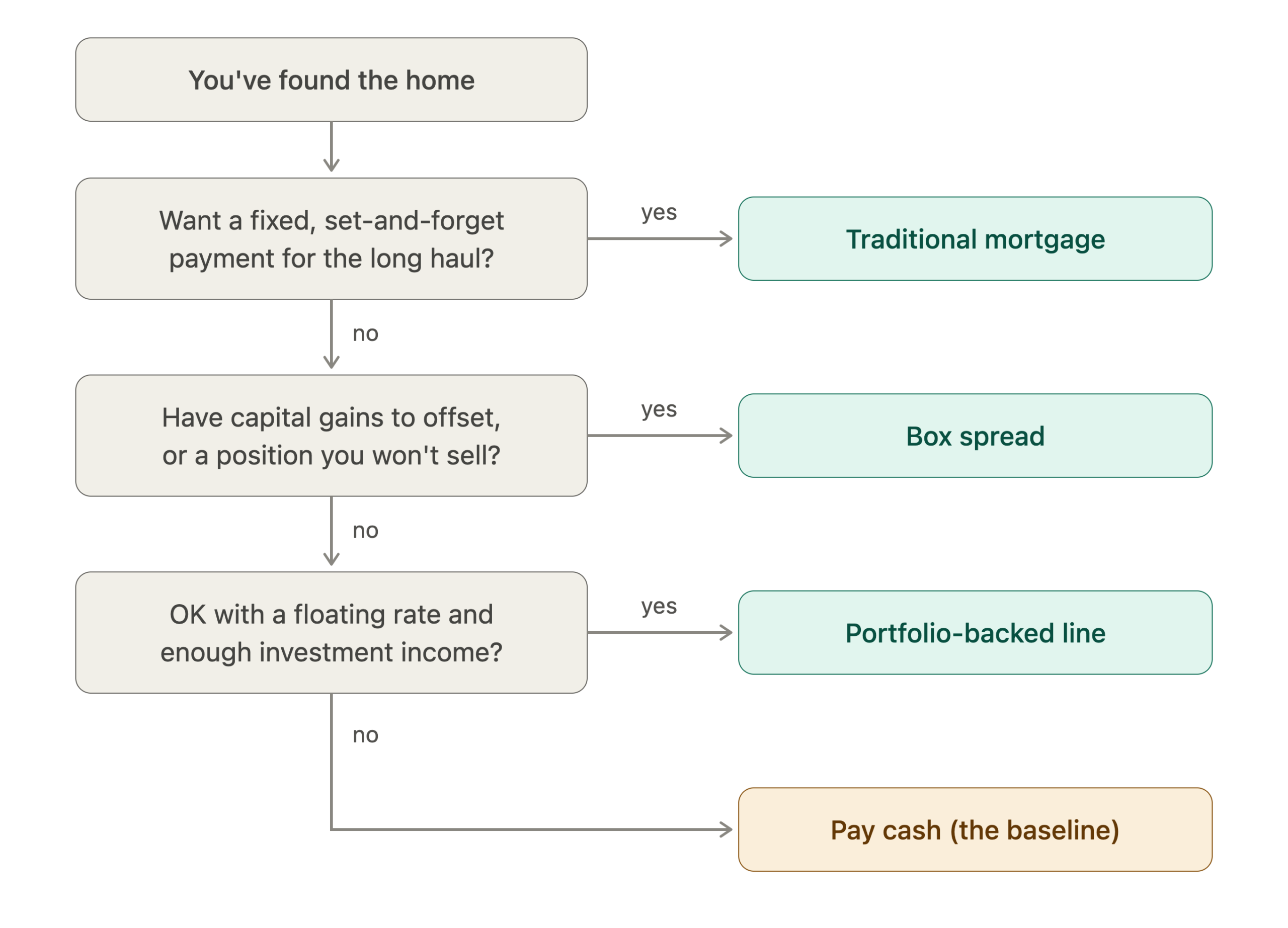
When we advise clients in this situation, we walk through four routes. The easiest way to keep them straight is by what you pledge and who you borrow from:
- Borrow against the house. A traditional jumbo mortgage.
- Borrow against the portfolio. A securities-backed line of credit.
- Borrow from the market. Synthetic financing through a box spread.
- Borrow from yourself. Paying all cash.
Let’s go through each option, the potential tax benefits, and the pros and cons. Pricing is live as of 9/11/2026 and subject to change.
Option 1: Borrow Against the House
Traditional 30-year jumbo mortgage
Best for: clients who want a straightforward, long-term fixed rate.
Mortgage interest is deductible only on the first $750,000 of acquisition debt (IRC §163(h)), a limit OBBBA made permanent in 2025. On a $1.5M mortgage, only half the interest is deductible.
*New for 2026* Your deductibility is also capped at only 35 cents on the dollar under the new OBBBA 2/37 rule, meaning high earners in the 37% bracket get a benefit as if they were in the 35% bracket.
| Year-1 math | Amount |
| Gross interest ($1.5M × 6.81%) | $102,150 |
| Deductible interest (first $750k only) | $51,075 |
| Non-deductible interest | $51,075 |
| Federal tax benefit (35% × $51,075) | $17,876 |
| Net after-tax cost → 5.62% effective | $84,274 |
Pros
- A mortgage amortizes. Part of each payment builds equity, a form of forced saving the interest-only options don’t provide.
- The best way to lock in a long-term rate you can run your finances on.
- No collateral call. Nobody is asking you for more in a bad market.
Cons
- The deductibility cap on the mortgage interest expense, which only gets worse the more you borrow.
- For complex balance sheets or entrepreneurs, underwriting can be challenging.
- If you have to sell assets for the down payment, you trigger capital gains.
Option 2: Borrow Against the Portfolio
Securities-backed line of credit
Best for: clients with strong balance sheets who were going to borrow above $750k anyway.
Instead of a mortgage, the client purchases the home in cash and draws on a securities-backed line of credit, investing the borrowed proceeds in the portfolio. That interest is investment interest under IRC §163(d): deductible up to net investment income, with any excess carried forward indefinitely, and with NO $750k ceiling.
Assuming pricing of SOFR plus 90 bps (pricing I’ve seen on recent large lines), it’s also a lower gross rate than the other options. Note it is still an itemized deduction, so the 2/37 cap applies and the benefit lands at 35 cents on the dollar.
| Year-1 math | Amount |
| Gross interest ($1.5M × 4.54%) | $68,100 |
| Deductible interest (100%, up to NII) | $68,100 |
| Federal tax benefit (35% × $68,100) | $23,835 |
| Net after-tax cost → 2.95% effective | $44,265 |
The order of the wires decides everything
Treasury Regulation §1.163-8T characterizes interest by what the borrowed money bought, not by what secured the loan. Follow the money.
Send the line of credit straight to the title company and those proceeds bought a house. That’s personal interest. Not deductible, not carried forward, not anything. You just paid 4.54% for the worst tax treatment available.
Pay cash for the house first, then draw and invest, and the identical dollars become deductible investment interest.
Caveat #1: investment interest is deductible only against net investment income, and qualified dividends and long-term capital gains do NOT count unless the client elects to treat them as ordinary (giving up the preferential rate). A client needs enough interest or non-qualified income to absorb the paid line of credit interest, or it carries forward.
Caveat #2: this assumes the Smiths have $1.5M sitting in cash or low-gain fixed income to buy the house outright. If they have to sell appreciated assets to raise cash, it may diminish the impact of the strategy.
Pros
- Easy to set up and draw.
- No prepayment penalties on variable rate draws.
- You may be able to “fix” rates for up to 5 years to mimic an ARM.
- Pay interest only, no principal, with no defined maturity. So if you wanted to buy the home, pay interest until death, have heirs pay off the line and owe little in capital gains on the home because of the step-up in basis, you can…
Cons
- Unless you fix your rate, it floats. Be cautious in rising rate environments.
- For this strategy to work, you have to invest in income-producing assets (no qualified stock dividends or tax-free income) unless you elect to treat all income as ordinary. In some cases that’s perfectly fine. Confirm with your CPA.
- If you don’t make that election, you shrink your investable universe to things like corporate bonds, options income, REITs, bank cash equivalents, non-qualified dividend stocks (preferred or common), etc.
- Municipal bonds are a problem here. §265(a)(2) disallows interest on debt used to buy or carry tax-exempt obligations, so holding munis in the pledged account can taint the deduction.
- Margin call or line call in a drawdown.
Option 3: Borrow From the Market
Synthetic financing with a box spread
Best for: sophisticated investors with a sizable portfolio who don’t want to sell assets for a down payment. If you own a concentrated stock position, listen up!
A client borrows synthetically using a box spread on broad-based index options (like SPX), collateralized by the portfolio, at a fixed rate well below conventional mortgages. Call it 4.80% locked for 5 years.
The financing cost is actually realized as a capital loss under IRC §1256 (60% long-term, 40% short-term), which can offset capital gains elsewhere on the balance sheet. Because it is a capital loss and not an itemized deduction, the OBBBA 2/37 cap does not touch it.
| Year-1 math (base case) | Amount |
| Gross cost ($1.5M × 4.80%) | $72,000 |
| Recognized as §1256 capital loss | $72,000 |
| Tax benefit offsetting LTCG (23.8%) | $17,136 |
| Net after-tax cost → 3.66% effective | $54,864 |
Upside case, if a client has short-term gains to offset. The 60/40 split means 40% of the loss is short-term. If that portion offsets short-term gains taxed at 40.8%, the blended benefit rises to 30.6% of $72,000, or $22,032, dropping the net cost to $49,968 and the effective rate to 3.33%.
One more thing worth knowing. A box spread is an options position marked to market, so the tracing rules that govern Option 2 simply don’t apply. Proceeds can go straight to escrow (or anything else you want to purchase) with zero effect on the tax treatment. That’s a huge operational advantage over the line of credit.
Pros
- Fixed for 1-5 years.
- No liquidation, so no capital gains triggered to fund the purchase.
- The cost is a capital loss, not an itemized deduction, so it sidesteps the 2/37 cap entirely.
- §1256 net losses can be carried back three years by election. No other option here offers that.
- No bank, no underwriting, no credit pull, no origination fee.
- Use of proceeds is irrelevant to the tax character.
Cons
- Excess net capital losses are capped at $3,000 a year against ordinary income.
- Mark-to-market timing. You recognize the loss annually while the cash cost arrives at maturity, so your CPA needs to be comfortable with Form 6781.
- It matures. In 1-5 years you roll or repay, and nobody knows the roll rate today.
- Margin and collateral risk. A drawdown can force liquidation at the worst possible moment.
- Execution has to be right. Broad-based, European-style, cash-settled index options only, or you lose §1256 treatment and pick up assignment risk.
- Practical minimum sizing around $100k units, and not every advisor or custodian will do it.
What if I just paid cash?
Paying all cash
Best for: clients who value simplicity and certainty over optimization, or who have idle low-basis cash.
Paying cash has no interest cost and no deduction, but it isn’t necessarily free.
First, if you have to sell assets to raise the cash, you might be hit with capital gains taxes. Second, there is an opportunity cost to not being invested. The below table illustrates this assuming 7% investment returns.
| The real cost of paying cash | Amount |
| One-time capital-gains tax (sell $1.5M, 50% gain × 23.8%) | $178,500 |
| Foregone portfolio growth — year 1 (7% × $1.5M) | $105,000 |
| Foregone portfolio growth — 5 years (compounded) | $603,828 |
| Total 5-yr drag (one-time tax + foregone growth) | $782,328 |
Cash can be right for SO many reasons. But, the opportunity cost can be great after you factor in taxes, capital gains taxes and forgone returns.
The bottom line on the three financing routes
| Option 1 Mortgage | Option 2 Portfolio-Backed Line | Option 3 Box Spread | |
| Amount financed | $1,500,000 | $1,500,000 | $1,500,000 |
| Stated rate | 6.81% | 4.54% | 4.80% |
| Gross annual cost | $102,150 | $68,100 | $72,000 |
| Deductible portion | $51,075 (first $750k) | $68,100 (up to NII) | Capital loss |
| Tax mechanism | Sch. A mtg int §163(h) | Inv. interest §163(d) | §1256 60/40 loss |
| Deduction benefit rate | 35% (2/37 capped) | 35% (2/37 capped) | 23.8% LTCG offset |
| Annual tax benefit | $17,876 | $23,835 | $17,136 |
| Net after-tax annual cost | $84,274 | $44,265 | $54,864 |
| Effective after-tax rate | 5.62% | 2.95% | 3.66% |
| Forces asset sale / gains? | Maybe (down pmt) | No | No |
| Strategy | Best for | Eff. after-tax rate | Net annual cost | Key advantage |
| Borrow against the house | Long-term fixed rate, set and forget | 5.62% | $84,274 | Fixed 30 years, builds equity |
| Borrow against the portfolio | Strong balance sheets borrowing above $750k | 2.95% | $44,265 | Cheapest today, 100% deductible, no cap |
| Borrow from the market | Investors avoiding asset sales | 3.66% | $54,864 | Fixed 5 years, dodges the 2/37 cap, no liquidation |
Putting a bow on it
Here’s what I want you to walk away with: every one of these strategies could be the right answer for you.
The mortgage is a great answer if you want a fixed payment you never think about again. The box spread is great for a concentrated position you refuse to sell. The line of credit is great if your income mix can absorb the deduction. And paying cash is great if certainty will help you sleep at night.
It literally pays to know that there are different options available.
This is why it pays to have your tax planning and investment strategy under one roof. At CURRENTS, we coordinate both so you aren’t left guessing.
If you’re weighing a purchase like this, it’s better to start these discussions before you start putting offers in. Give me a holler.