You just sold your business and the cash hit your account. Should you invest it all now, or phase into the market?
This is one of the heaviest questions I hear from clients. For years, your net worth lived inside something you mostly controlled, a business whose value moved on your terms. Now it is a number on a screen that changes every second the market is open.
My best attempt at putting this feeling into words is: this is a scary amount of money that I don’t want to lose, and I know how hard it was to earn. From one business owner to another, I know you have already paid the price in blood, sweat, and tears.
So, should you invest now or later?
The obvious right answer depends on your goals and your risk tolerance, but there is more to it than that. The data points hard in one direction. Your nerves usually point the other way. A good decision accounts for both, so let’s start with the numbers.
What the data says
I ran the numbers using monthly Shiller S&P 500 data going back to 1945, testing one thing: does phasing into the market actually help your returns 12 months later?
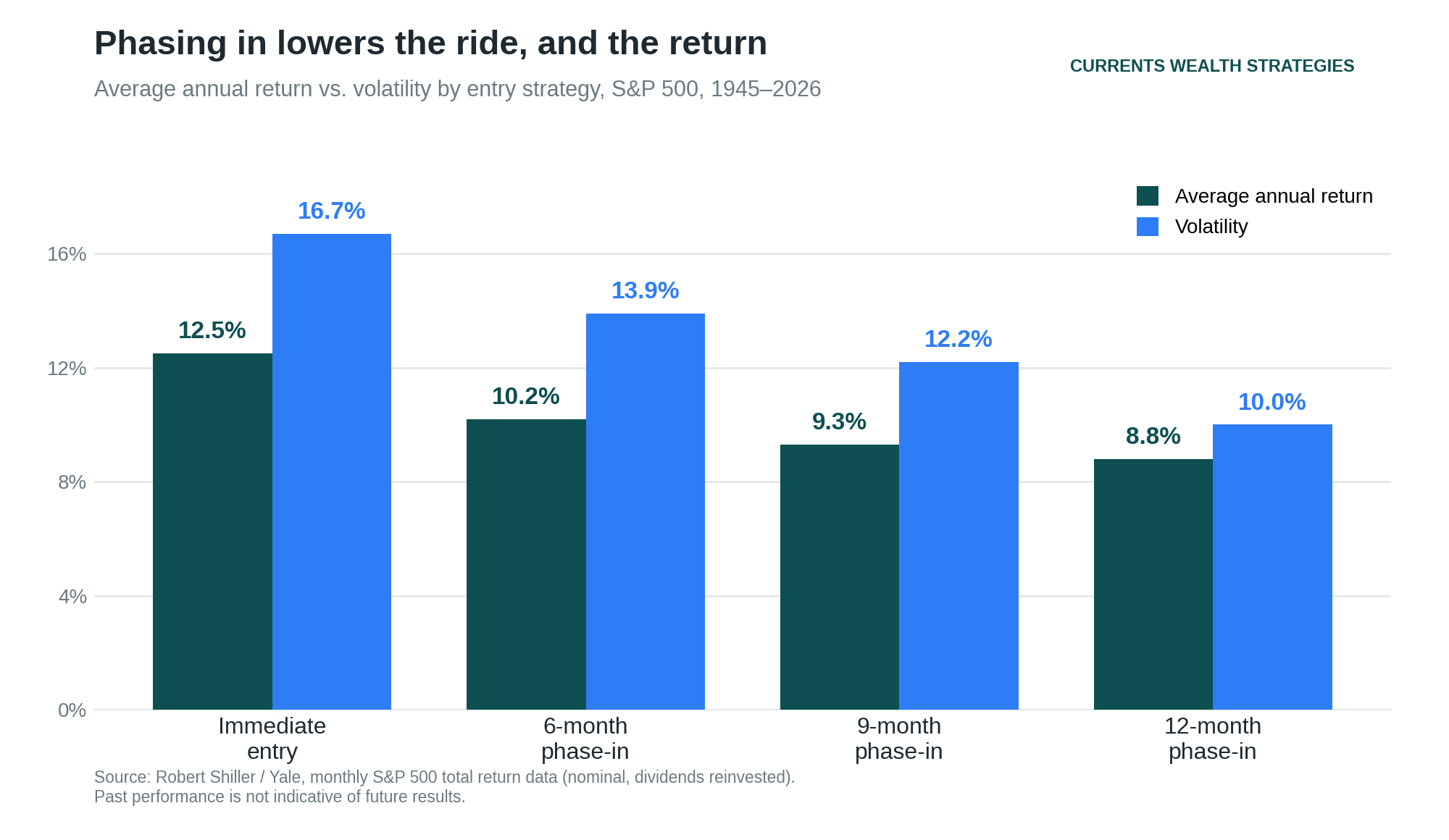
- Immediate entry: 12.5% average annual return, 16.7% volatility
- 6-month phase-in: 10.2% return, 13.9% volatility
- 9-month phase-in: 9.3% return, 12.2% volatility
- 12-month phase-in: 8.8% return, 10.0% volatility
A quick note on the test itself. The portfolio here is the S&P 500 with dividends reinvested, using Robert Shiller’s monthly data back to 1945. It’s a pure stock position, no bonds, no cash cushion, which is deliberate. The point is to show the full force of market volatility a windfall feels when it lands in equities. The figures are index returns, so they don’t subtract fees or taxes, and a real-world portfolio with some bonds in it would ride a little smoother than what you see here.
Going all in produced the highest return by a clear margin. Meanwhile, phasing in over a year cost roughly four percentage points of average annual return. On a seven-figure portfolio, that is a huge opportunity cost.
Based on history, the math provides us a clear winner. Invest it all, now. So why should anyone phase in?
The case for phasing in
The answer is behavioral. A portfolio that swings six figures in an afternoon will rattle someone who has never experienced it, and rattled investors sell at the worst times. Phasing in cuts that volatility, by almost a third in the Shiller data, which means it’s far easier to stay in your seat when markets get ugly. And staying in your seat is the whole game. An investor who panics and sells ends up well behind one who eases in and holds. The few points of return you give up are a fair price for the discipline you buy.
I always tell clients to listen to their own stomach, but you have to know what it is telling you. There is a difference between nerves and dread. I have never not felt a pit in my stomach before an important, worthwhile investment, whether it was stocks, leaving a high-paying banker role, starting a business, or even getting married. Nerves are normal. You push through them by committing to a plan you trust. Dread is different. Dread is your gut telling you the risk is genuinely wrong for you, and the answer to that is a smaller position or a slower entry, not willpower.
Investing is a lot like surfing. I love to surf. I’m always a happier, more grounded person when I leave the ocean. When the waves come, you decide to commit and paddle or let them pass. Commit, and you might get an awesome ride. Hesitate, you either miss the wave or even fall. The more time you spend in the water, the easier it is to read which waves are worth riding, and you learn you don’t have to take the first one. But no matter your experience level, once you pick your wave, you have to commit to earn the best ride. It’s the same with investing. If you don’t commit to a proven plan, you’ll falter and likely get burned when the market drops. And it will drop, at some point. Only paddle out to your comfort level.
Waiting for a dip rarely works
Once people accept that they should get invested, the next instinct is to wait for a better price. Sit in cash, let the market drop, then buy in. Common sense, right?
History makes it sound easy. Market pullbacks are routine. We ran the daily performance numbers on the S&P 500 back to 1980. The index fell an average of about 14% at some point within any given year, yet still finished the year positive in 35 of those 46 years.
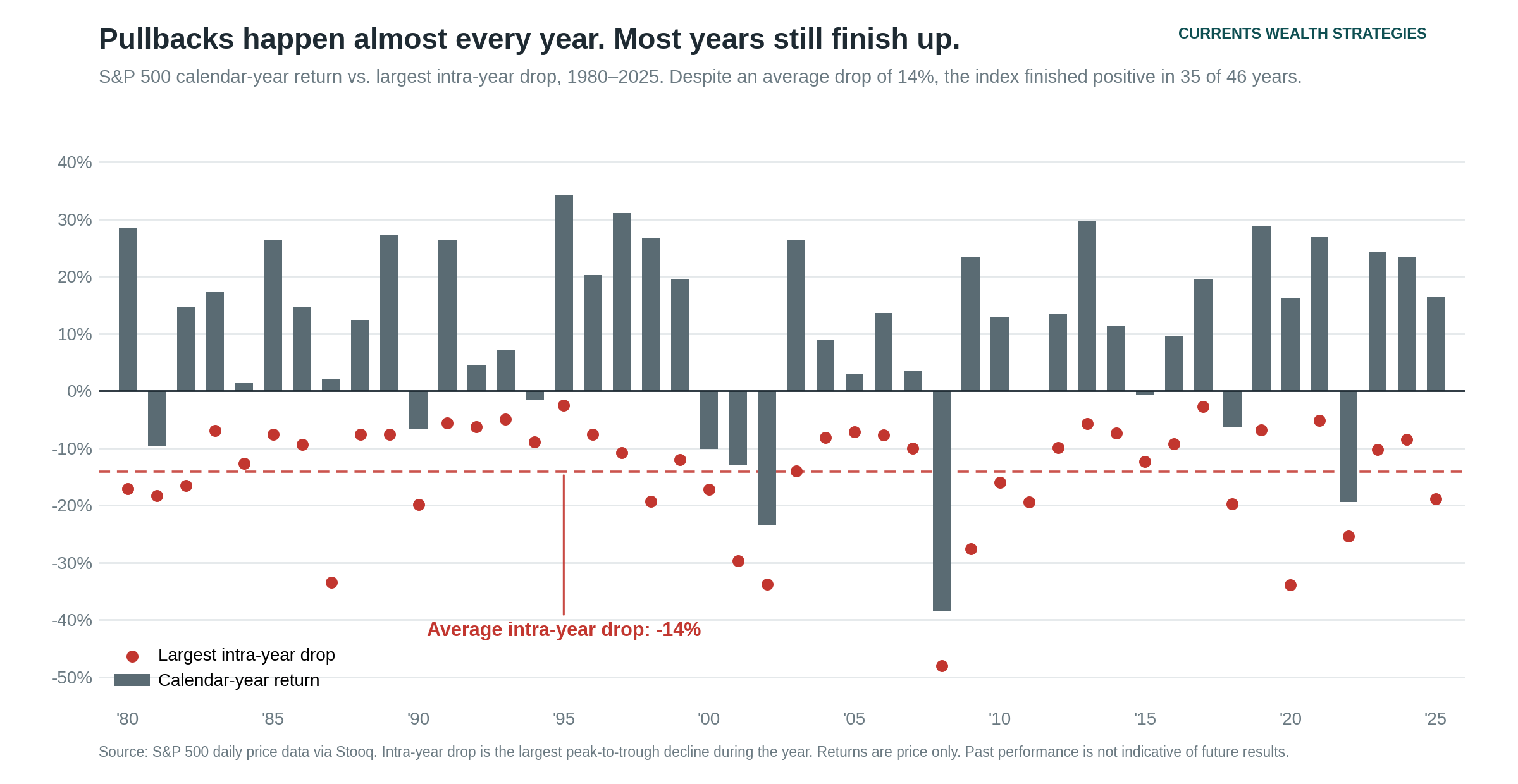
So how is this hard to implement? We know a dip is coming, eventually.
From my perspective, the catch is that you have to time it twice, get in at the bottom and out near the top. This is simply trying (key word here) to time the market. What I’ve found is that the drop that creates a buying opportunity scares most people out of using it. Trust me when I say that the real dependable edge is time in the market, not timing it.
I had a client once who claimed he would only invest after a 10% selloff. When the market finally dropped 10%, his response was, “I think it has another 5% to go.” It dropped again, same answer. The number he was waiting for kept moving, because what he actually wanted was certainty, and the market never sells that. Another version that I’ve seen sounds smart, but ends the same way: “Call me when the S&P hits X (random target below current price) and I’ll start.” In a bull market that number often never comes, and the price of waiting is every point of return you missed twiddling your thumbs.
Where you invest matters as much as when
Getting invested is the right call. Where those dollars go is the next one, and the price you pay going should play a big part in that decision.
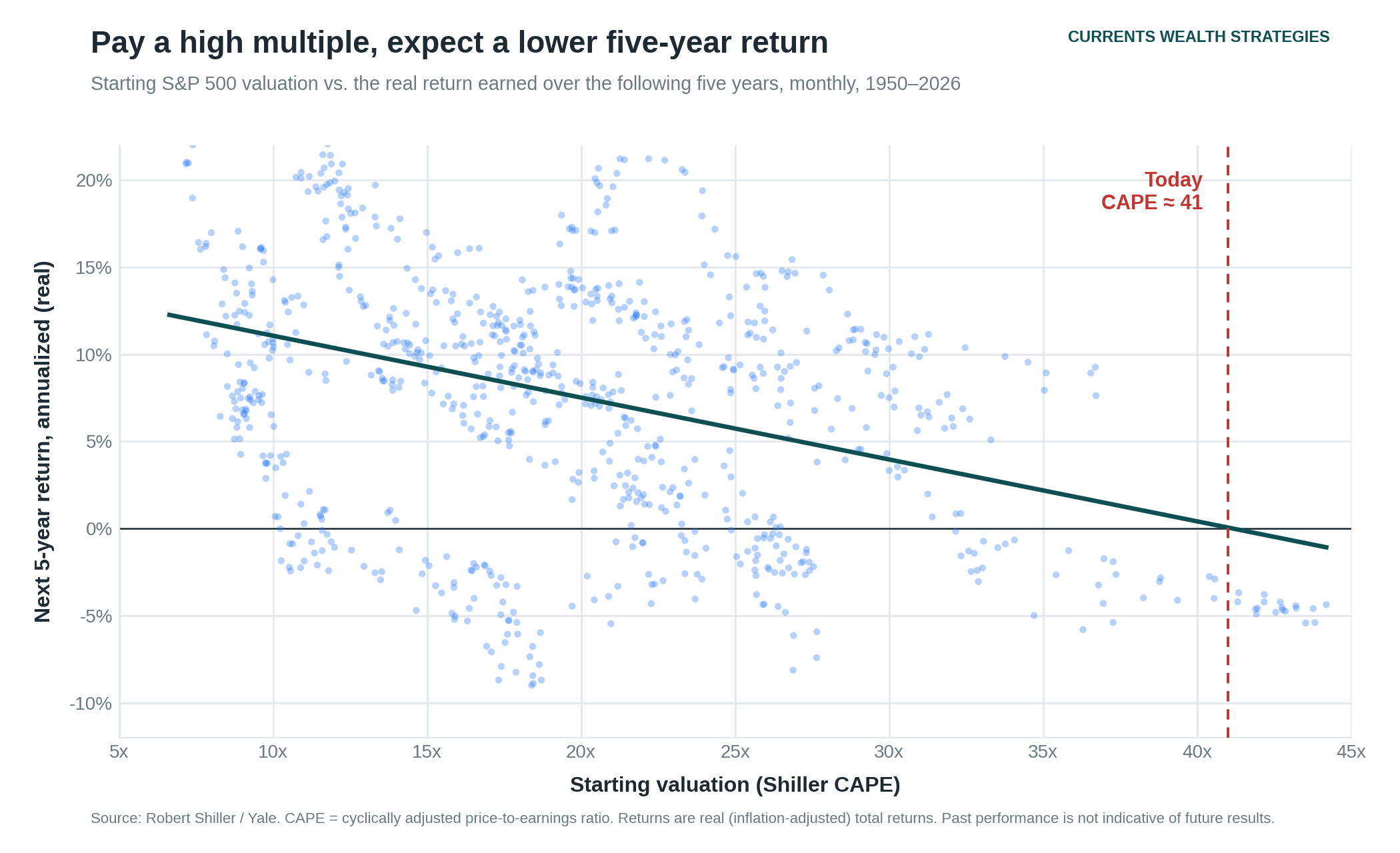
Measured by the Shiller CAPE ratio, which compares price to a decade of inflation-adjusted earnings, the S&P 500 sits near 41 today, well above its long-run norm. Valuations say little about where the market goes over the next year, but they say a lot about the next five: the higher the multiple you pay going in, the more muted your forward five-year returns tend to be. History argues for diversifying your investments intentionally rather than parking everything in the most expensive corners of the market. Food for thought: international developed and emerging markets trade at meaningfully lower valuations than the U.S. right now.
I also look to the larger return driver: earnings growth. On that front, the U.S. still leads, particularly in technology. Cheap markets can stay cheap when nothing is growing, and expensive markets can keep climbing when earnings deliver. This is simply an observation, not a recommendation on where to invest.
It is fine to hold cash while you build your plan
One last note before wrapping up: give yourself permission to be patient. It is perfectly fine to park liquidity somewhere safe, take a breath, and let the moment settle before you commit to an investment or a lifestyle change. A few weeks in cash while you acclimate to a new wealth reality will help you make future decisions from a place of calm, rather than in the rush of post-transaction excitement.
The bottom line
Lump sum or phased in, U.S. or global, what matters is that the plan is built around your goals, your timeline, your taxes, and the volatility you can genuinely tolerate.
A real thought partner earns their keep at exactly these moments, helping you avoid the kind of move you can’t take back.
If you’ve recently sold your business and you are staring at that number wondering what comes next, have a conversation before you click buy.
Nate Willardson, CFP® is the founder of Currents Wealth Strategies, a planning firm for people navigating retirement, business sales, and liquidity events. He spent over a decade managing portfolios for ultra-high-net-worth families at a world-renowned private bank, and now brings that institutional-level thinking to individuals and families at the moments that matter most.
This is educational content only and does not constitute investment, tax, or legal advice. Past performance is not indicative of future results.