Your Stock Is Worth Millions. So Why Doesn’t It Feel Safe?
The short answer: When most of your wealth sits in one stock, the biggest risk isn’t financial. It’s the quiet tax it puts on your life: a retirement you can’t quite commit to, plans kept in pencil, a price you check more than you’d admit. Concentration risk never shows up on your balance sheet, yet for many successful professionals it’s the largest risk they own. The fix is less about your portfolio than about getting your life back.
The number says you’ve made it. Your gut isn’t so sure.
You did something genuinely hard. You bet big on one company, and you were right. Today, a single stock makes up a large slice of your net worth, a number your younger self would have called impossible.
So here’s the strange part. You should feel free. Instead, a lot of people in your position describe something closer to a low hum of unease. You check the price more than you’d admit. A bad earnings call ruins a Tuesday. You’ve been “meaning to do something about it” for two years, and you haven’t.
That feeling has a name. And no, it isn’t an upset stomach, indigestion, or… a midlife crisis. It’s concentration risk: having so much of your net worth in one stock that your whole financial life rises and falls with it.
The invisible risk on your balance sheet
Your balance sheet is honest about some risks. It lists what you owe. It will even tell you your exposure to interest rates if you ask nicely. What it won’t tell you is that one stock has quietly started running your life.
Here’s what that looks like day to day:
Your retirement vision isn’t really yours.
You’d like to step back at 55. But the plan only works if the stock holds, so your timeline now answers to a board, a product cycle, and a market you don’t control.You can’t fully commit to the good stuff.
The second home, the sabbatical year, the big gift to your kids. The money is “there,” but it’s not settled, so you keep these plans in pencil instead of pen.It’s a quiet strain at home.
Often one spouse built the position and still believes in it, and the other lies awake doing math. Concentration risk has a way of becoming a relationship topic nobody wants to start.Selling feels like betrayal.
This is the one I run into most. The stock isn’t just an asset, it’s part of your story, so trimming it can feel like giving up, even when the smart move is simply to stop betting your whole future on one outcome.
The data agrees with your gut
You have high conviction in your company. That’s great, and I can relate. I spent a decade at a large bank and built up a good amount of its stock (and have sold most of it since). I started CURRENTS too. I know conviction. But at some point, conviction and diversification answer two different questions, and it’s worth letting the data weigh in on the second.
Roughly 40% of the stocks in the Russell 3000 have suffered a “catastrophic loss” at some point, defined as a drop of 70% or more from their peak, with most never recovering (Cembalest, The Agony & The Ecstasy, J.P. Morgan Private Bank, updated 2024).
This doesn’t just happen to penny stocks. Plenty were household names everyone was certain about, right up until they weren’t. (R.I.P. Blockbuster, Kodak, Nokia, and Sears.)
The reason smart people hold on tight is mostly psychology. Research points to a few usual suspects that keep concentrated holders frozen:
Endowment effect: we overvalue what we already own
Overconfidence: especially when you know a company from the inside
Recency bias: assuming the last decade predicts the next
Translation: the instincts that helped you hold through the volatility that built your wealth are now the ones working against you.
It was never about the stock
Ok Nate, so you’re telling me my brain is compromised and that’s why I can’t address my stock position?
Sort of. Managing a concentrated position isn’t just about deciding whether your company is good. It’s about deciding whether your life should depend on the answer.
A plan to diversify doesn’t make you a pessimist about your stock. It’s a mindset shift. You start saying: my peace of mind, my retirement, and my plans for my family matter more than the next earnings report. The company can still do great. You just stop needing it to.
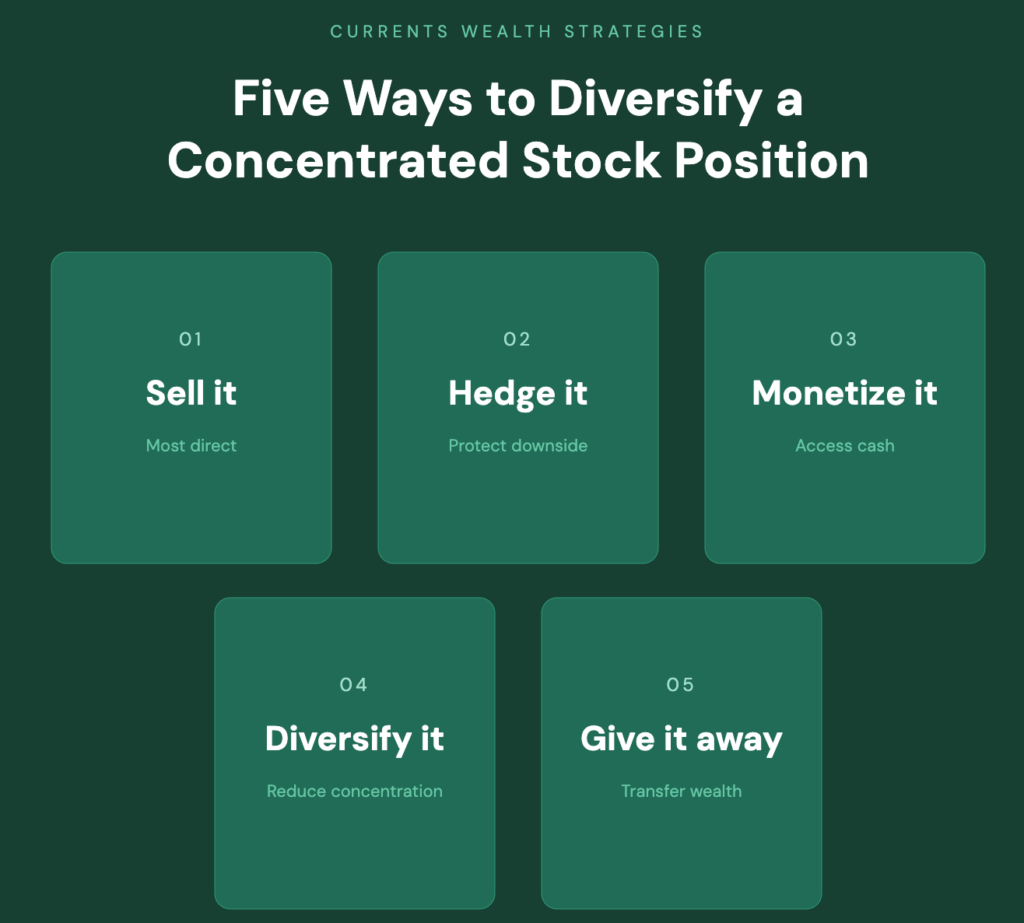
And no, this doesn’t mean selling everything tomorrow and writing an enormous check to the IRS. There are several well-established, tax-aware ways to reduce concentration over time, from staged selling to hedging, borrowing, diversifying, and charitable strategies. I covered all of them here: Five Ways to Diversify a Concentrated Stock Position.
The point of this article isn’t the toolkit. It’s permission to use it.
What freedom actually feels like
People expect the payoff here to be financial, because managing an outsized stock position usually involves some selling. But the real payoff shows up as something much more personal first.
You stop checking the price on weekends. You set a retirement date in pen. You commit to the trip, the home, the gift, because the plan no longer hinges on one company having a good quarter. The wealth you built finally feels like yours instead of something you’re nervously babysitting.
That’s the real return on managing this risk. Not a perfect tax outcome, though we work hard for that too. It’s the quiet that comes from knowing your life is no longer a leveraged bet on a single ticker.
Start with the life, not the spreadsheet
The most important part of a retirement plan isn’t a spreadsheet. It’s you.
What does an ideal day actually look like? Does it excite you? Get clear on the life you want first. The numbers are there to serve that life, not the other way around.
So here’s where the real work starts, and it’s simpler than it sounds:
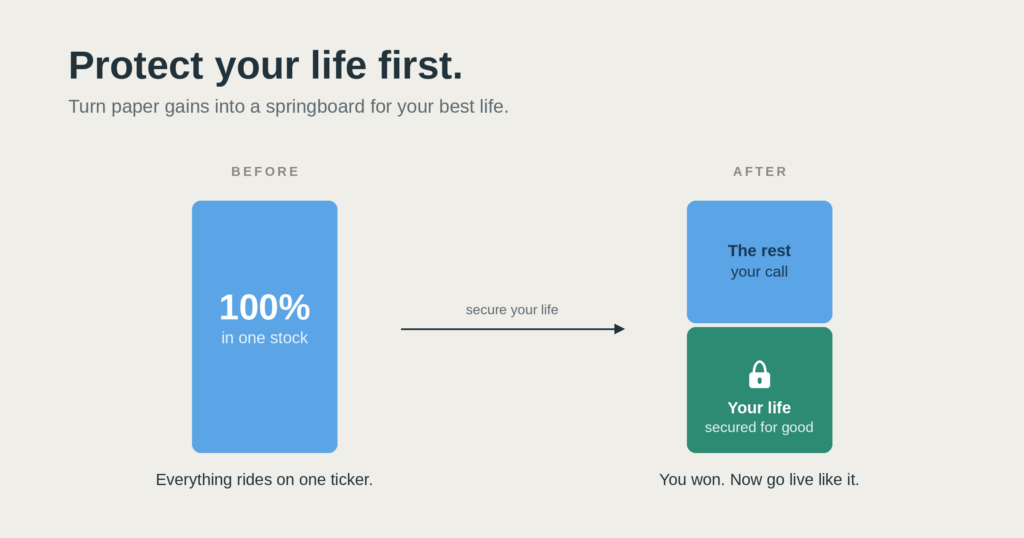
- Find your number. Pin down the exact amount that needs to come off the table to fund your family’s core lifestyle for good.
- Protect it first. Lock that piece in before anything else moves. It becomes your floor, and it stays untouched.
- Decide from clarity. With the essentials secured, every remaining choice gets made from calm instead of anxiety.
You won. Now go live like it!
Frequently Asked Questions
How much of my net worth should be in a single stock? A common rule of thumb is to keep any one stock under 10% to 20% of your investable net worth. Above that, you have meaningful concentration risk. Plenty of people carry far more, sometimes 80% or more in one position, which is where the risk stops being theoretical and starts dictating your decisions.
Why does a concentrated stock position cause stress even when it’s up? Because an unrealized gain you’re afraid to touch is still a decision you haven’t made. The position keeps a claim on your attention, your timeline, and often your relationships, no matter which direction it moves. That low-grade pressure is the part no statement measures.
Can I reduce a concentrated position without a huge tax bill? Often, yes. Strategies like staged selling, hedging, borrowing against the position, and charitable giving are designed to reduce concentration risk or soften the tax impact. The right combination depends on your cost basis, tax bracket, and timeline.
When is the right time to start? Earlier than you think. The most powerful approaches reward planning, and clients who begin two to three years ahead of a goal or exit have far more options than those who start a few weeks before. Don’t wait until poor stock performance forces your hand.
Strategy descriptions are for educational purposes only. Every strategy involves trade-offs and tax, legal, and compliance implications that vary by individual circumstance. This material does not constitute investment, tax, or legal advice. Consult qualified advisors before implementing any strategy. Currents Wealth Strategies LLC is a registered investment adviser.
Nate Willardson, CFP® is the founder of CURRENTS Wealth Strategies, a fee-only, fiduciary financial planning firm in Chandler, AZ. After nearly a decade advising ultra-high-net-worth families at a global private bank, he built CURRENTS to deliver that same level of advice without the institutional constraints. He specializes in concentrated equity, business exits, and retirement transition planning.