What SpaceX tells us about new issues, index funds, and where investment returns actually come from.
Unless you’ve had your head under a rock, you saw the largest IPO in history come to market this June. SpaceX is another Elon Musk company with a grand vision, and for the first time you could buy a piece of it.
Quick primer if you tuned it out: SpaceX builds and flies rockets, sells satellite internet through Starlink, and has been pushing into AI infrastructure. The stated mission is making life multiplanetary. The actual business today is launch services and selling connectivity to places that don’t have any.
Surprisingly, I got fewer client calls about buying it than I expected.
Since the IPO, it’s been a wild ride. Shares opened at $150 on June 12. Four days later they touched $225.64 and the company was briefly worth more than Amazon. Rockets, Starlink, Mars, the first trillionaire, the largest offering ever completed. Who couldn’t love that story?
The stock closed at $108.20 on July 31. That’s 52% off the June high and 28% below where it opened on day one. All within seven weeks.

I’ll be the first to say I’m not taking a victory lap here. I want every American company to do well, and especially one with a mission this ambitious.
I just don’t buy IPOs, for myself or for clients. Not because I know something about SpaceX that you don’t. Because I know the history, and the history is unusually consistent.
The song remains the same
IPO returns consistently lag benchmarks 12 months after issuance. A favorite study of mine from Dimensional looked at more than 6,000 US IPOs and found they generally trailed their industry benchmarks. Widen the lens to 1980 through 2024 and the average IPO returned 5.6% versus 13.2% for US equities.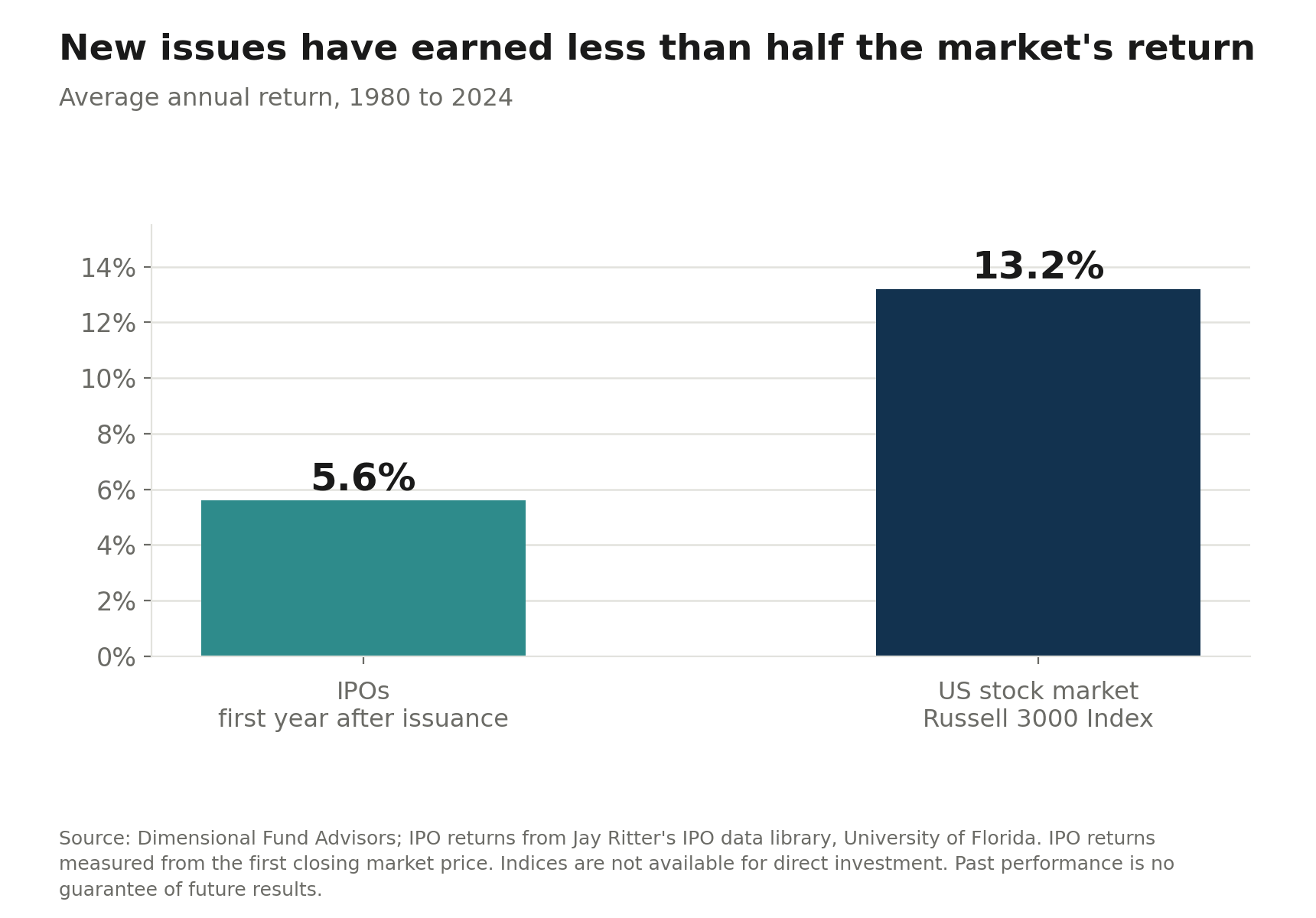
The six-month picture is worse. Among the largest US IPOs since 2005, 90% trailed the market over their first six months.
And these aren’t obscure companies. Facebook trailed the market by 65 percentage points in its first twelve months. Uber by 26. Rivian by 50. Kenvue by 53. Groupon by 95. Some worked, Visa and Hilton among them. The median came in 33 points behind the Russell 3000.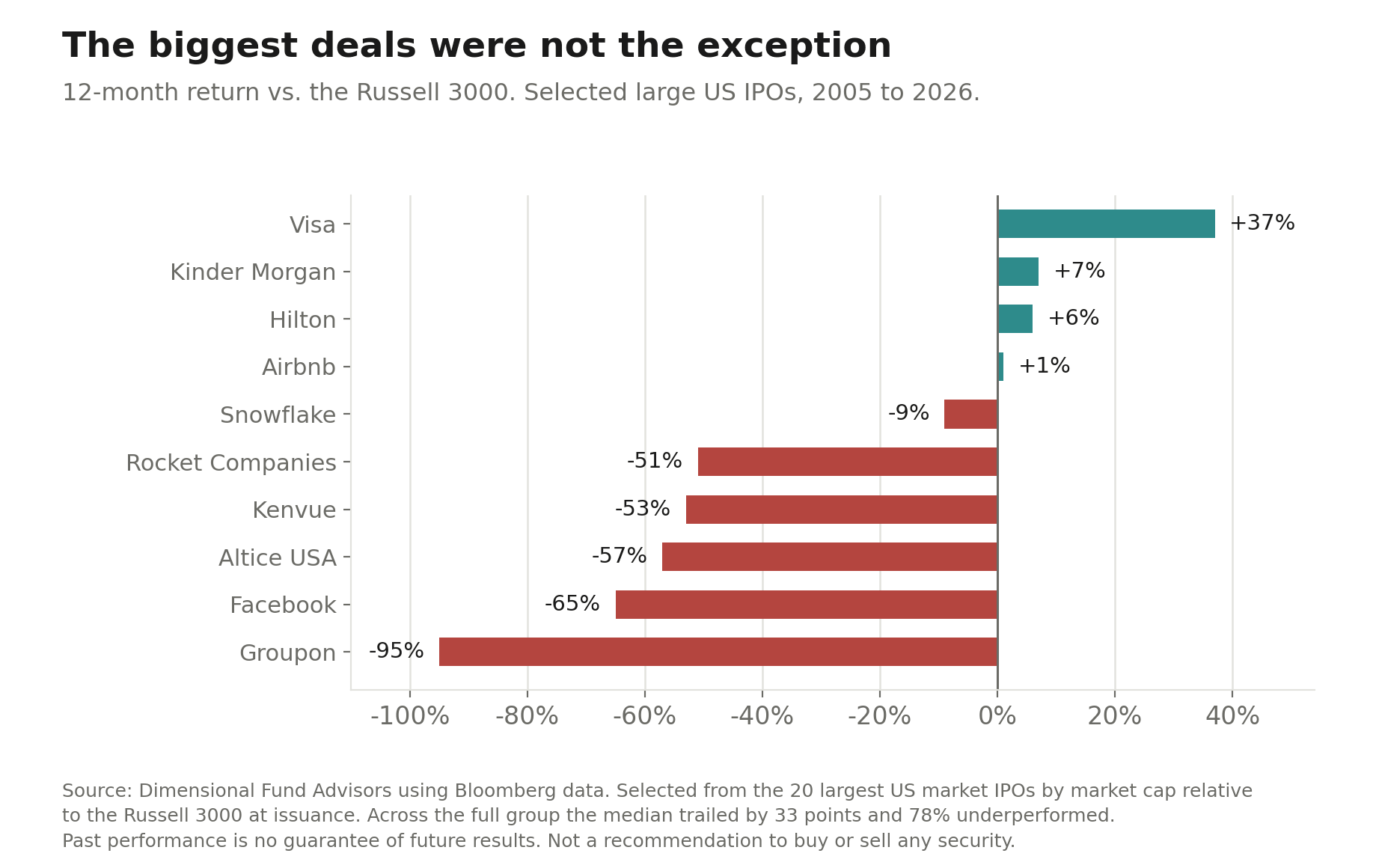
IPOs aren’t bad
Companies seeking growth capital use IPOs as an alternative to raising debt. They sell ownership to you, me, and institutional buyers, then use the proceeds to grow the business. If the business grows, the company does well and so do we. It’s an essential part of our economy.
They tend not to perform well early on for a few specific reasons. Companies going public are usually 1) expensive relative to book value, 2) unprofitable, and 3) reinvesting enormous amounts of capital into growth. From 2005 through 2024, the average US IPO came to market at 6.15 times book value while the broad market sat at 2.70. More than 60% had negative earnings, versus 22% of Russell 3000 companies.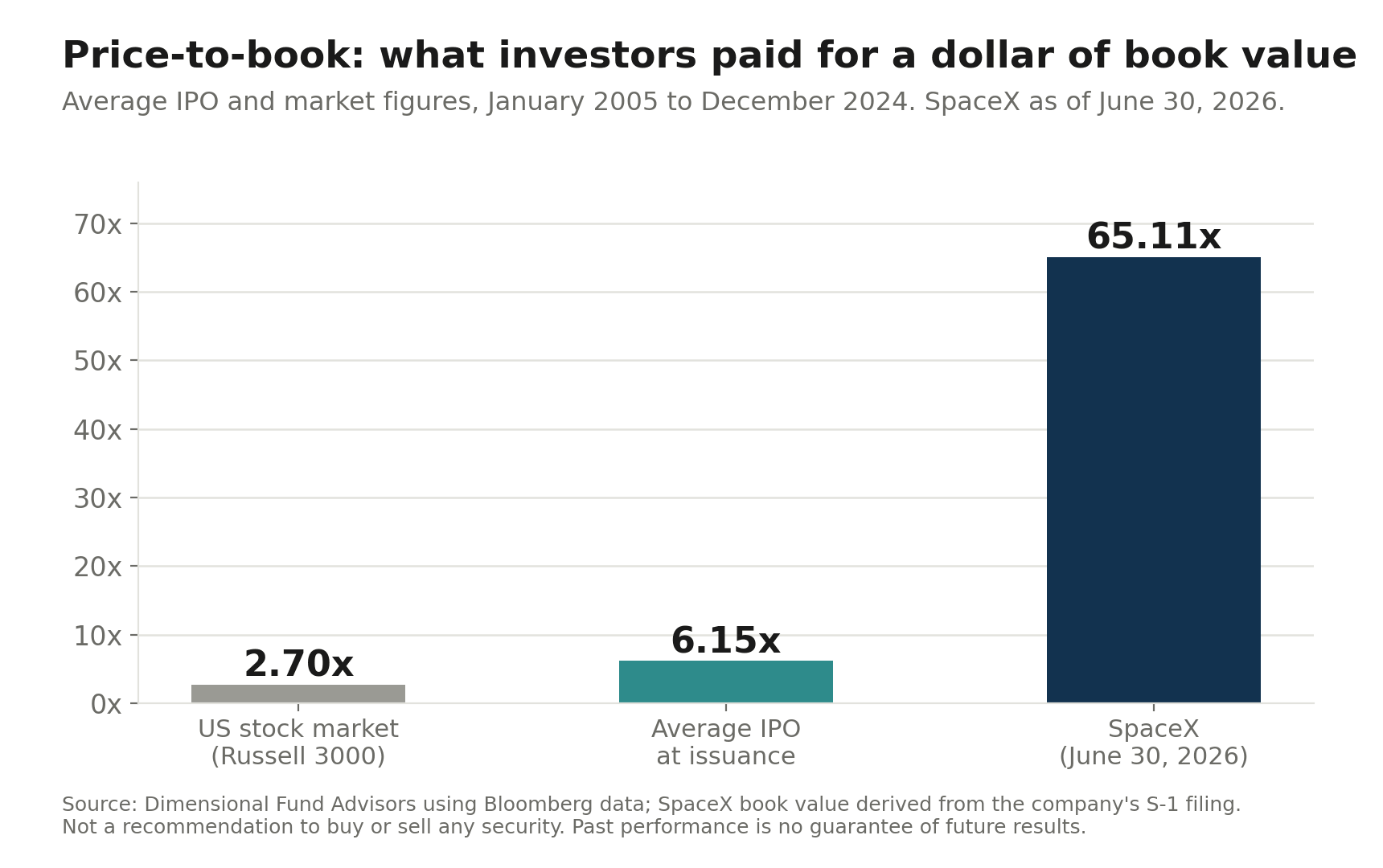 Decades of academic work, including the research Dimensional builds its funds around, points to those same three characteristics as drivers of lower expected returns. High price relative to book. Weak profitability. Aggressive asset growth. IPOs are a concentrated dose of all three at once.
So the underperformance isn’t a mystery. Over the long run, markets reward profitable companies bought at reasonable prices. Those are the ones worth owning.
So how do I invest in the best companies and avoid the poor ones?
Most clients I work with intuitively know that diversifying their investments is a great way to grow their wealth by being vaguely right instead of precisely wrong. So index funds should protect you from IPOs and other young, unprofitable companies, right?
Not necessarily. Believe it or not, you may already own SpaceX and not realize it. Russell and CRSP indexes can add a new listing after five trading days. MSCI takes ten. The Nasdaq-100 takes fifteen. Only the S&P Composite 1500 makes a company wait twelve months and show profitability first.
If you hold a total market fund or a Nasdaq-heavy position, a company that lost billions last year showed up in your portfolio automatically. Nobody asked you. And as SpaceX’s lock-ups roll off and its free float, meaning the shares actually available to trade, climbs from roughly 4% to about 50% over the next year, its weight in cap-weighted indexes is projected to grow right along with it. Your exposure goes up as insiders become free to sell, not because the business proved anything.
That’s the quiet version of concentration risk, and I find it constantly in portfolios when I bring on new clients.
What we do instead
A little inside baseball.
At Currents, our portfolios tilt toward three things: smaller companies, lower relative prices, and higher profitability. That’s not a market call and it isn’t a hunch. It’s the same body of research that explains the IPO results, pointed in the other direction.
The cleanest illustration I’ve seen is what happens when you simply remove the worst-characteristic companies from the small cap universe. From 1975 through 2025, the US small cap market compounded at 13.79% a year. Small growth companies with low profitability returned 6.74%. Companies with the highest asset growth returned 2.53%. Strip both groups out and what’s left compounded at 14.99%.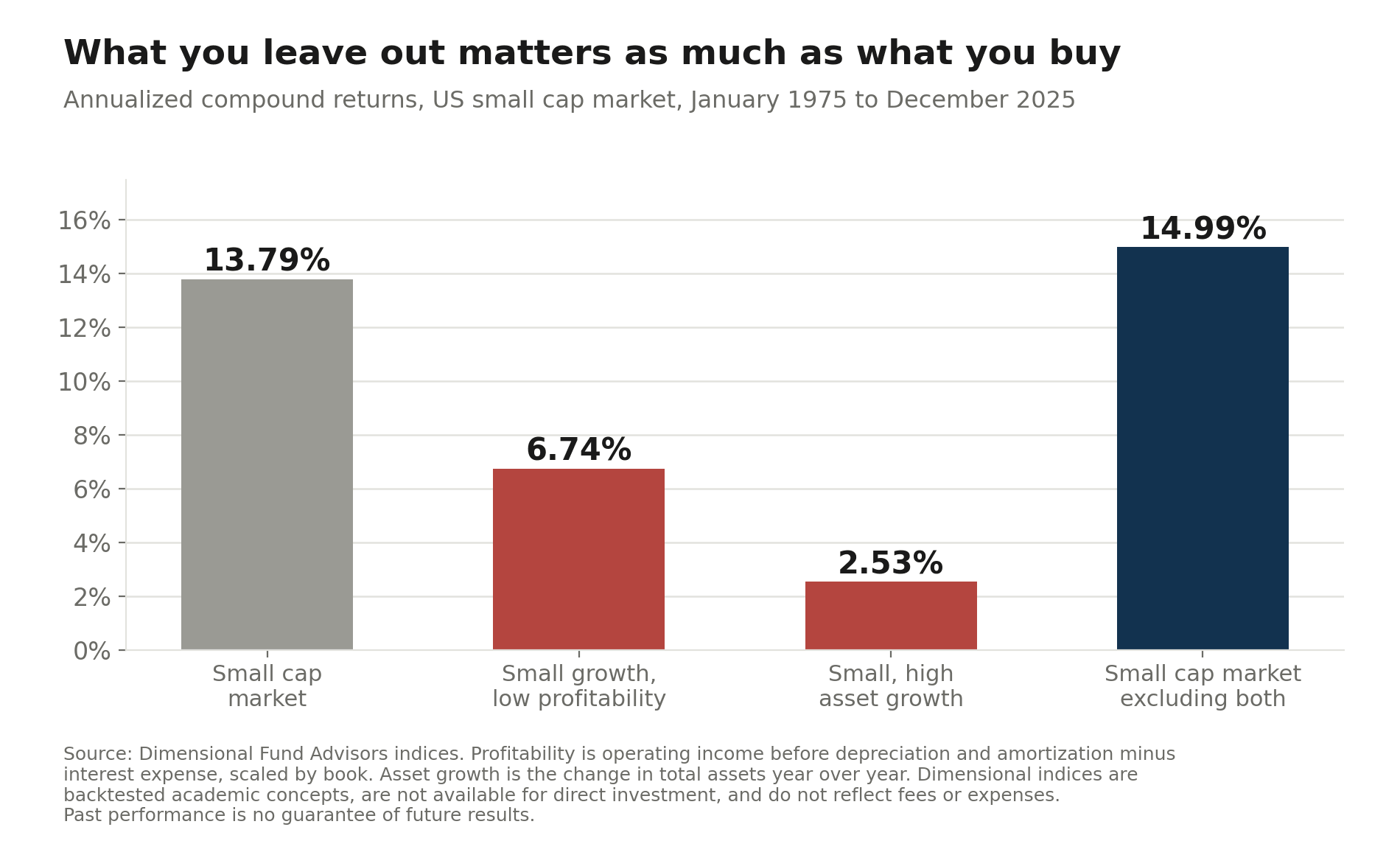
That 1.2% a year isn’t from picking winners with a crystal ball. It’s from declining to own a specific, identifiable set of losers. The same exclusion added about 0.98% annually in developed markets outside the US and 1.62% in emerging markets.
Now an honest caveat, because I’m an open book.
These tilts don’t pay off every quarter. In the second quarter of 2026, US growth stocks beat value by more than twelve points and lower-profitability companies beat higher-profitability ones. There are stretches, sometimes long ones, where a disciplined portfolio looks boring next to the one chasing the next big story. That’s the cost of admission, and I’d rather you hear it from me now than discover it in a statement.
The bet isn’t that this quarter looks good. The bet is that over the ten, twenty, thirty years you’re actually invested, owning profitable companies at reasonable prices beats owning expensive, unprofitable ones.
“The stock market is a device for transferring money from the impatient to the patient.”
— Warren Buffett
The takeaway
You don’t need to have an opinion on SpaceX. I’m genuinely fine if you own it outright. You just need to know what your portfolio owns and why.
Three questions worth asking about your accounts this month:
What do I actually own? Not the fund names. The characteristics underneath: valuation, profitability, how much sits in the top ten holdings.
What got added without my say-so? Index methodology decides that, not you, and the rules differ meaningfully between funds you might assume are interchangeable.
Is my strategy built on evidence or on narrative? Both feel like conviction from the inside. Only one has a track record you can audit.
Happy investing.
Nate Willardson, CFP®, is Managing Partner of Currents Wealth Strategies in Chandler, Arizona. He spent more than a decade managing portfolios for ultra-high-net-worth families at a global private bank before founding Currents to bring that same institutional discipline to individuals and families navigating retirement, business exits, and liquidity events.
This material is for informational and educational purposes only and does not constitute investment, tax, or legal advice, or a recommendation to buy or sell any security. Named securities are used solely as illustrations and may be held in portfolios managed by third-party fund managers. Past performance is no guarantee of future results. Indices are not available for direct investment and index returns do not reflect fees or expenses. Currents Wealth Strategies LLC is a registered investment adviser.