The most successful savers I meet are often the most anxious about retiring.
On paper, they have already won. The 401(k) is maxed. No debt. The portfolio is healthy. The math says they can stop working tomorrow and be fine. And yet, sitting across the table, I can’t feel any excitement. It is some version of the same quiet acknowledgement: “It’s exciting, but also a bit terrifying.”
If that is you, you are not being irrational, and you are not alone. The 2026 EBRI Retirement Confidence Survey found confidence slipping again, with worker confidence down to 61 percent and retiree confidence down to 73 percent, pressured by inflation, health care costs, and worry about Social Security. The unease you feel is widespread, and it is not a sign you saved too little. It is a sign you are running into a real and well documented dilemma.
The problem: you trained for 30 years for the wrong final exam
For three decades you got very good at one thing. Saving. You learned to defer, to accumulate, and watch the balance climb. That instinct built everything you have.
Then retirement arrives and quietly changes the rules. Living off three million dollars is a completely different situation compared to building three million dollars. Suddenly the questions are unfamiliar and the stakes feel higher. Which account do you pull from first? How much can you actually spend without the creeping thought of “what if I run out”? What does my tax bill look like once I withdraw from retirement accounts?
The discomfort is not a character flaw. It’s completely normal to feel confused when you’ve been an expert at one game and you’re about to be handed a new one.
Why it feels like this: the paycheck cliff
For your entire working life, money arrived on a schedule. Retirement removes that safety net. The deposits stop, and now your nest egg has to last for as long as you live.
Behavioral researchers call the fear of outliving your money “longevity risk.” It’s hard to plan for your assets to cover the rest of your life when your “expiration date” is unknown. As humans, we tend to overestimate our lifespan when we are old and underestimate it when we are young.
There is also a real risk for your investments: sequence of returns risk. This is the risk that a rough stretch of markets in the first decade of retirement does far more damage than the same stretch later, because you are withdrawing while prices are down and selling shares you can never buy back. The anxiety is emotional, and emotional problems do not respond to spreadsheets alone.
So you end up in a strange standoff. The numbers say “you are objectively safe.” Your gut says “I don’t feel safe.” Both are telling the truth.
The hidden risk nobody warns you about: spending too little
I have a lot of empathy for someone who is honestly worried about a market downturn. You probably remember the 2008 financial crisis, the dot-com bust, the Covid crash, the lost decade for stocks that ran through the 2000s, and the punishing inflation of the 1970s. The list could go on.
What’s fascinating to me is that despite all of those, what most people end up struggling with is NOT running out of money. It is being too afraid to enjoy it.
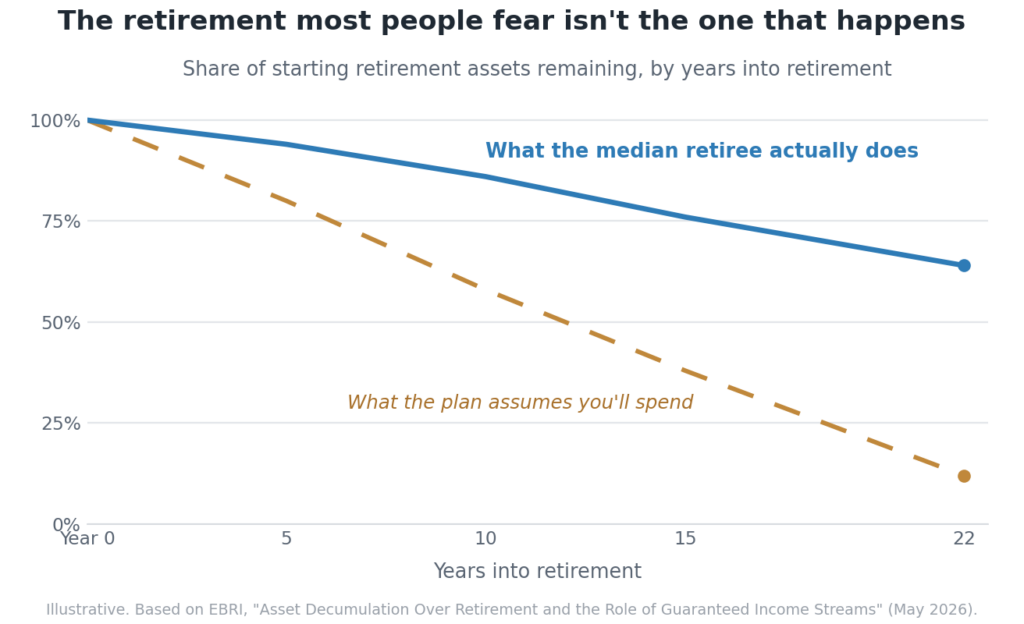
The Employee Benefit Research Institute studied how people actually draw down their savings over decades, and the results are striking. Roughly one in three retirees still has 100 percent or more of their starting assets by their mid-80s. Among higher-asset households, the median had drawn down only about 42 percent of their nest egg more than two decades into retirement. They did not spend it. They barely touched it. EBRI’s own research director, Craig Copeland, put it plainly: when you see that many people in their 80s still sitting at 100 percent, you are looking at people who were “way too conservative.”
This is sometimes called the decumulation paradox, and the chart below is the cleanest way to see it. The dashed line is the orderly spend-down most plans quietly assume. The solid line is what real people do when experience is in the driver’s seat.
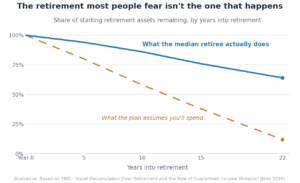
That gap between the two lines is not prudence. It is a life not lived. It represents vacations not experienced and moments not enjoyed because of the fear of running out of money.
Some of that caution is baked into the advice itself. The 4 percent rule, the famous guideline from William Bengen’s 1994 research, was built to answer one narrow question: what withdrawal rate survives a bad 30-year stretch? It was a safety floor, not a happiness target. It was never meant to tell you how to live.
What actually builds confidence: income you can feel
Confidence, it turns out, is not really a math output. It is a feeling that comes from rehearsal and structure, and there is good evidence for that.
David Blanchett and Michael Finke found that retirees spend “lifetime income, not savings,” meaning people happily spend a predictable monthly check but freeze up when asked to draw from a portfolio. J.P. Morgan’s research points the same direction: retirees who hold 60 to 80 percent of their wealth in guaranteed income spend roughly 42 percent more than those with less than 20 percent. Same net worth. Very different lives. The difference is not the size of the pile. It is how safe the income feels.
That is the whole game. If you want to feel confident spending, you have to make the income feel as steady as the paycheck you are giving up.
The solution: take retirement for a test drive first
The people who walk into retirement calm are almost never the ones with the biggest portfolios. They are the ones who practiced.
You would not buy a house you had never walked through. You should not retire into a life you have never test driven. So we run a rehearsal before the paycheck actually stops. For a month or two, we pretend the salary isn’t there, withdraw the real retirement “paycheck” out of the investment accounts, and live on it. You get to feel the mechanics while you still have the safety of a job to fall back on. Most people discover one of two things. Either the plan feels fine, and the fear quietly loses its grip. Or it surfaces a real problem, like a number that was off or a withdrawal sequence that creates an ugly tax bill, while there is still time to fix it.
The same goes for the life. Go visit the retirement town before you build the whole plan around it. Better to learn in a long weekend that the dream spot is not actually the life you want than to learn it after the move.
The goal is to walk into your first Monday of retirement already knowing it feels right.
Best practices to build retirement confidence before you retire
- Run a paycheck rehearsal. Spend three to six months living off a portfolio-funded “paycheck” while you still have earned income as a backstop. Confidence comes from rehearsal, not reassurance.
- Give yourself a permission-to-spend number. Decide in advance what you are allowed to spend guilt-free each year. A defined ceiling is what frees you to actually use it.
- Cover your essentials with predictable income first. Match fixed costs (housing, food, insurance) to guaranteed or stable income from Social Security, a pension, or an income annuity. People spend far more freely when the basics are not riding on the market.
- Build a cash buffer for the scary years. Holding three to five years of spending in cash or short bonds lets you avoid selling stocks in a downturn, which is the real engine of sequence of returns risk.
- Use a flexible, not flat, withdrawal plan. Spend a little more in strong markets and trim in weak ones. Static rules ignore that real retirement spending tends to be higher early, lower in the middle, and higher again late in life.
- Write down the order you will tap accounts. A clear, tax-aware withdrawal sequence across taxable, tax-deferred, and Roth accounts removes a recurring source of “am I doing this wrong” anxiety.
- Test the life, not just the money. Trial-run the travel, the move, the slower schedule. Find out what you actually want before the plan is set in concrete.
- Coordinate it as one plan. Investments, taxes, income, and estate decisions either work together or quietly work against each other. The confidence comes from the whole picture lining up, not from any single account.
You spent decades earning the right to live life on your terms. The last piece of the work is giving yourself permission to.
Nate Willardson, CFP® is the founder and Managing Partner of Currents Wealth Strategies, a fiduciary, fee-only firm in Chandler, Arizona that helps pre-retirees and affluent families navigate retirement, business exits, and liquidity events with clarity and a tax-first strategy. Connect on LinkedIn or at currentswealthstrategies.com.
Sources
- Employee Benefit Research Institute, 2026 Retirement Confidence Survey (April 2026): ebri.org
- Employee Benefit Research Institute, Asset Decumulation Over Retirement and the Role of Guaranteed Income Streams (May 2026): ebri.org
- David Blanchett and Michael S. Finke, Retirees Spend Lifetime Income, Not Savings (2024)
- J.P. Morgan Asset Management, Guide to Retirement (2025): jpmorgan.com
- William P. Bengen, “Determining Withdrawal Rates Using Historical Data,” Journal of Financial Planning (1994)
- Michael Kitces, “Understanding Sequence of Return Risk,” Nerd’s Eye View: kitces.com
Investment advisory services are offered through Currents Wealth Strategies LLC, a registered investment adviser. This article is for educational purposes only and is not an offer, solicitation, or personalized financial, tax, or investment advice. Investments involve risk, including possible loss of principal. Consult a qualified adviser before acting on any strategy discussed here.