You spent thirty years doing everything right. You maxed out your 401(k). You contributed to your IRA. You let compound interest do the heavy lifting, and now retirement is close. On paper, it looks great. Here’s what most people don’t see coming: there’s a tax bill built into that balance, and it’s been growing right alongside your savings.
The problem: you made a deal with the IRS
Every dollar in a traditional 401(k) or IRA came with an implicit agreement: pay taxes later. The government let you defer taxes for most of your working life, but deferred doesn’t mean forgiven. When money comes out of tax-deferred accounts in retirement, it’s taxed as ordinary income, the same way your paycheck was.
When you turn 73, the IRS requires you to start withdrawing from your traditional IRA, SEP IRA, SIMPLE IRA, and most retirement plan accounts, whether you need the money or not. These are called Required Minimum Distributions, and skipping one is not an option. The penalty on a missed or short RMD can run as high as 25% of the amount you should have taken.
Here’s what that looks like for a hypothetical couple. Say David and Karen retire at 65 with $1.5 million in a traditional IRA. It grows at 6% a year. By 73, that balance has climbed to roughly $2.4 million, and their first RMD is about $90,000, added to their taxable income whether they need the funds or not.
One RMD, three separate tax hits
That $90,000 doesn’t just show up as ordinary income. It pulls on three levers at once.
Your tax bracket climbs. Stack a $90,000 RMD on top of a pension, stock dividends, or real estate income and it’s easy to land in a high tax bracket, maybe even the same rate you paid in your peak earning years.
Medicare gets more expensive, two years later. IRMAA, the income-related surcharge on Medicare Part B and Part D, kicks in for 2026 at $109,000 (single) or $218,000 (married). Cross the line by a dollar and you owe the full surcharge for that tier, not a prorated slice.
Your Social Security gets taxed too. Combined income, your AGI plus half your Social Security benefit, above $44,000 (married) means up to 85% of your benefit becomes taxable. Those thresholds haven’t been adjusted for inflation since 1994, so more retirees cross them every year without their income actually growing in real terms.
Run David and Karen’s numbers and their RMD plus taxable Social Security adds up to roughly $115,000 in income. After the standard deduction, they land around $9,500 in federal tax, before state tax, before IRMAA, before Medicare Part D. One withdrawal, three bills.
The fix: Roth conversions
A Roth conversion moves money from a traditional IRA (pre-tax) into a Roth IRA (post-tax). You pay tax on the conversion amount now, typically out of pocket, in a year you control. From that point forward, the money grows tax-free in your Roth account and comes out tax-free, with no RMDs during your lifetime.
The window to do this well is typically between your retirement and age 73, when income tends to be at its lowest and you have the most control over your own tax rate. Once RMDs start, the window is largely closed.
What this looks like: a hypothetical planning case
Here’s a hypothetical analysis for Betty and Ryan, both 56, planning to retire at 67. At the time of the analysis, 81% of their $2 million portfolio sat in tax-deferred accounts, exactly the setup where a conversion strategy has the most room to work.
The plan: convert from tax-deferred accounts into Roth every year from 67 to 72, sizing each conversion to stay just under the next IRMAA tier. Total converted over six years: roughly $2.37 million.
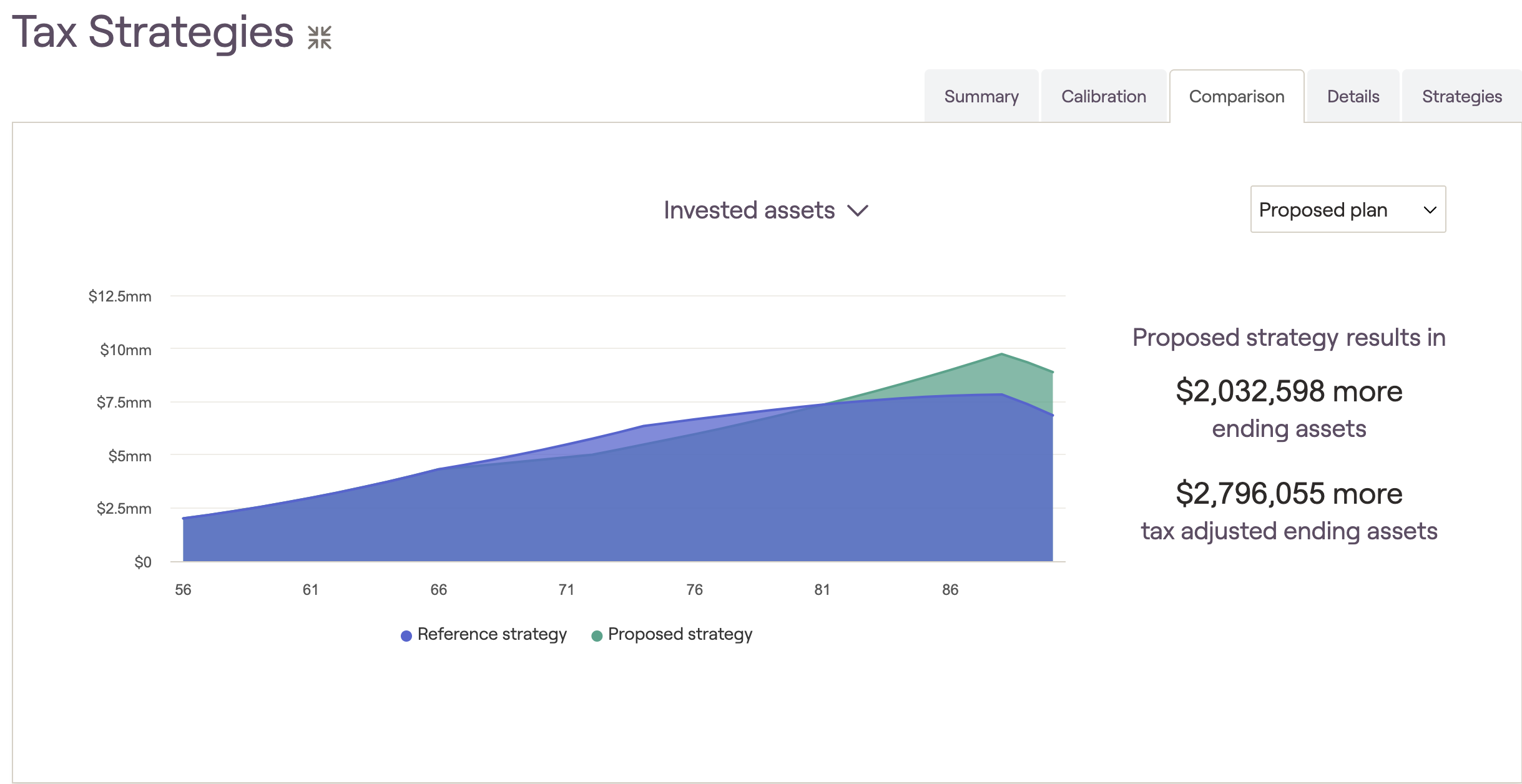
Against a scenario plan with no conversions, the numbers held up:
- $2.8 million more in tax-adjusted ending assets
- $46,569 less in lifetime federal taxes, despite paying more tax upfront
- $3.3 million less in cumulative RMDs over the plan
That last point is the one worth sitting with. Converting meant paying more tax during the six conversion years, but it shrank the size of every RMD for the rest of their lives.
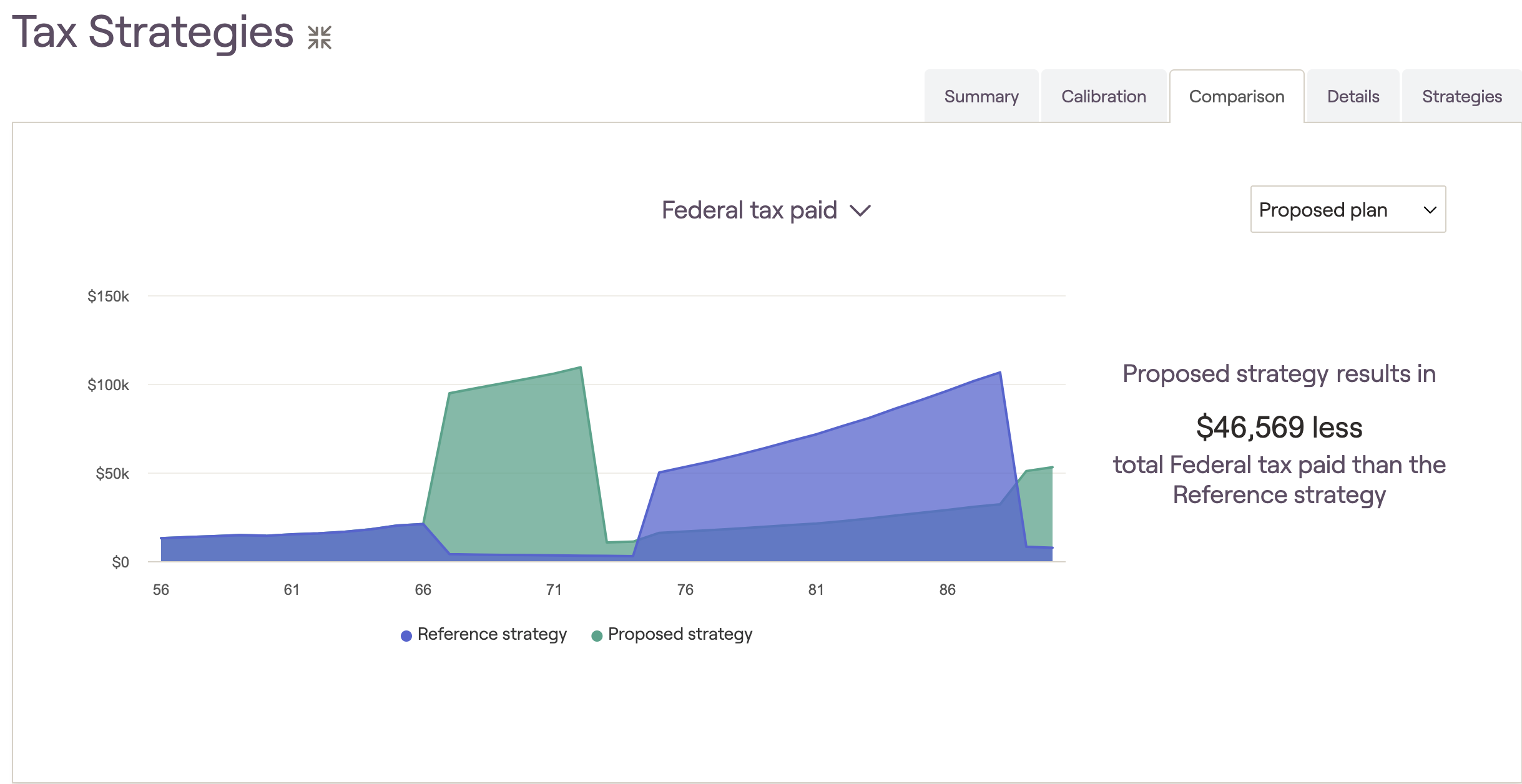
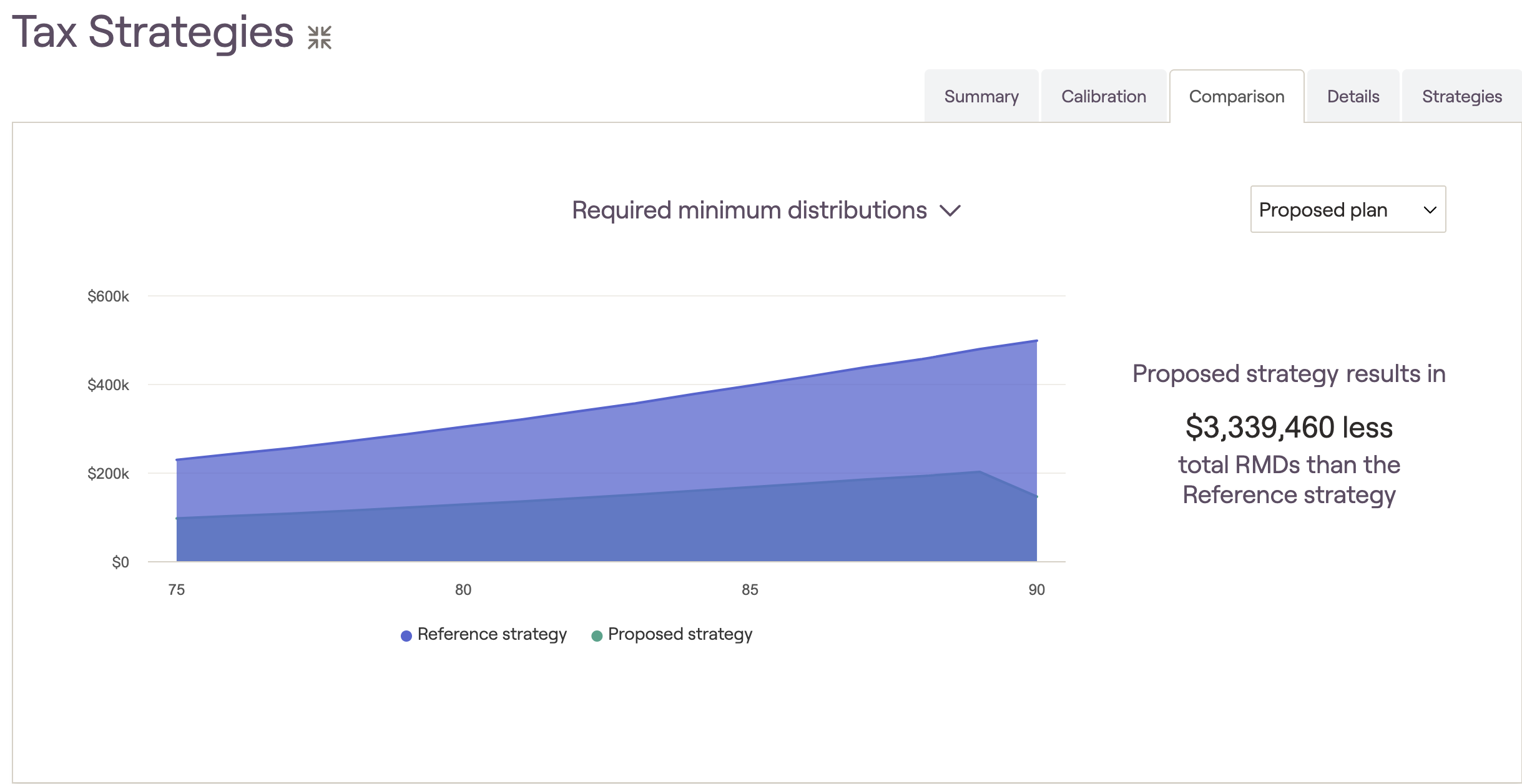
The conversions were also sized deliberately, filling up the current bracket without spilling into the next one, rather than converting everything in one shot.
By age 90, the non-conversion plan still had 87% of the portfolio sitting in tax-deferred accounts, a large, fully taxable balance to leave behind. The Roth conversion plan flipped that to 90% tax-free. That’s a massive difference for any heirs.
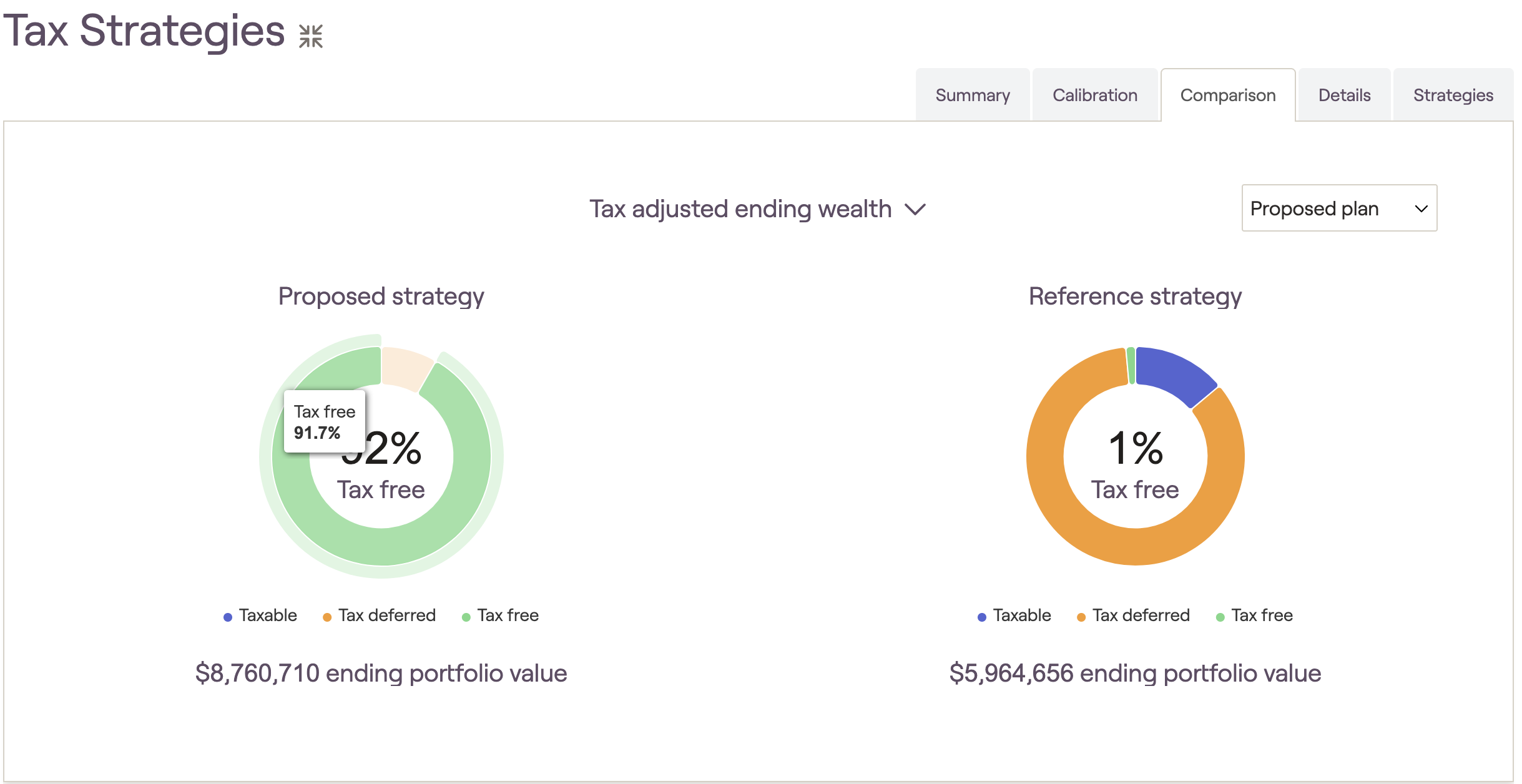
Under the SECURE Act, most non-spouse beneficiaries have to empty an inherited IRA within ten years. If your kids inherit a large traditional IRA during their own peak earning years, that forced income stacks on top of their salary at likely their highest bracket. A Roth IRA is still emptied within ten years, but every dollar comes out tax-free.
So should everyone do a Roth conversion?
When a conversion isn’t the right move
This isn’t an automatic yes, if:
- You expect a lower tax bracket in retirement than you’re in today
- You’d have to pay the conversion tax out of the IRA itself, which shrinks the amount left to grow tax-free. The break-even point stretches out so far, or requires such strong investment returns to catch up, that the math rarely works.
- Your IRA balance is modest enough that future RMDs were never going to push you into a higher bracket
- You’re planning to move from a high-tax state to a no-tax state soon; wait until after the move
The right answer depends on your numbers, not a rule of thumb.
Final caveats
If you spend any time on social media where “financial advice” gets handed out freely (yes, the quotation marks are intentional), you’d think Roth conversions were the holy grail and nothing could possibly go wrong.
Here are a few instances where things could go wrong:
| Scenario | Why It Hurts |
| Future tax rate drops significantly | You paid 22% now, but only owed 15% later |
| Short time horizon | Not enough time for compounding to build a meaningful advantage |
| Forced to tap the Roth for short-term needs | Loses tax-free compounding before it has time to pay off |
| Market drops right after you convert, and you withdraw early | Locks in the loss before markets have a chance to recover |
The window is real, and it closes
The families who come out ahead here aren’t necessarily the ones who saved the most. They’re the ones who planned the withdrawal side of retirement with the same intention they brought to the saving side.
If you’re within a few years of retirement on either side of it, this is worth mapping out now, not guessing at later.
Nate Willardson, CFP® is the founder of Currents Wealth Strategies, a planning firm for people navigating retirement, business sales, and liquidity events. He spent over a decade managing portfolios for ultra-high-net-worth families at a world-renowned private bank, and now brings that institutional-level thinking to individuals and families at the moments that matter most. This is educational content only and does not constitute investment, tax, or legal advice. Past performance is not indicative of future results.
Sources: IRC Sec. 401(a)(9) and the SECURE 2.0 Act of 2022 (RMD rules and penalties); 2026 IRMAA thresholds and federal tax brackets, Retirement Tax Services 2026 Tax Guide; Social Security benefit taxation thresholds (unchanged since 1994), U.S. Master Tax Guide; SECURE Act of 2019 (10-year inherited IRA rule); planning analysis run in RightCapital’s Tax Strategies module.