You know the theory about how straight-A students rarely make the best entrepreneurs?
There’s something about being rewarded for following the rules makes it hard to break them decades later.
The same thing happens to savers. The best ones turn out to be the worst spenders.
They spend a career doing everything right. They work hard, are high earners, invest consistently, and live below their means. Then they retire, and they can’t bring themselves to touch their accounts.
It usually gets blamed on the market, taxes, or the general state of the world. However, that’s almost never what’s actually going on.
Levels of Control
There are things in life that you have complete control over. Like – whether you save or spend. What time you get up. Saying “please” and “thank you” to your waiter. Whether you hit the snooze button or get right out of bed.
Then there are things you can’t control at all. No matter how die-hard my support, the San Diego Padres might never win a championship (please, just one in my lifetime). And I am powerless to stop the neighborhood landscaping crew, who genuinely believe 6:00 AM is a civilized hour to fire up a leaf blower.
Retirement operates on similar levels of control, too.
Total control. How much you save, how much you spend, your asset allocation, and where those assets are located across different account types.
Some control: how long you work, what you earn while you’re working, and to a degree your longevity, assuming you took reasonable care of your body.
No control: market returns, inflation, and tax policy.
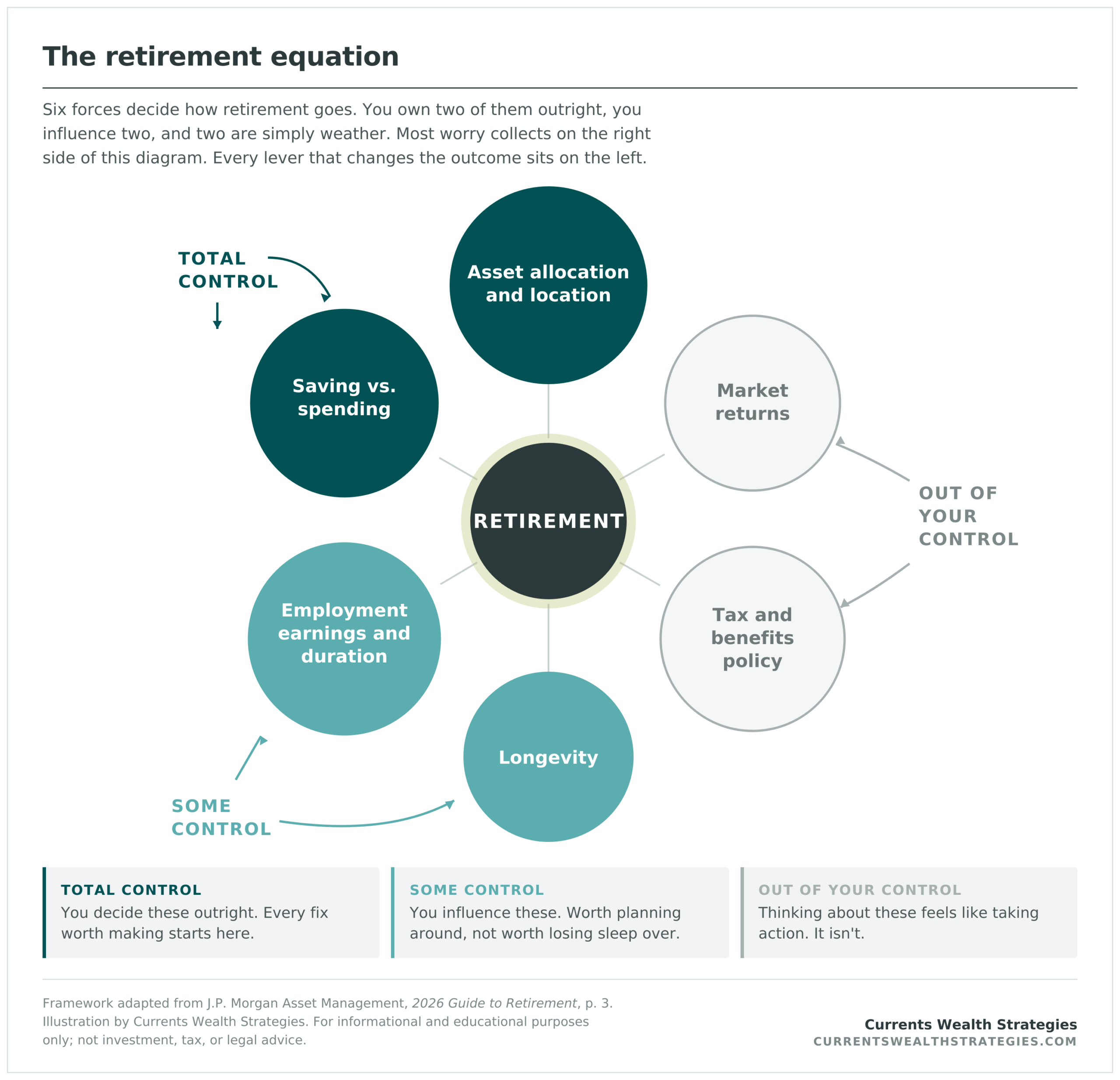
Most of the “retirement spending anxiety” I encounter comes from spending too much energy on the “No Control” bucket.
If you fall in this camp, you’re probably trying to predict the next market crash, monitoring every word from the Federal Reserve or lying awake doing portfolio math at 2am. You have no control over any of it, but thinking about it feels like you’re taking action.
There is an expensive truth hidden in that anxiety: worry doesn’t protect your wealth. It just makes you underspend.
The Evidence
JP Morgan looked at real transaction data from households with $3 to $5 million in retirement wealth. Households with more guaranteed income (think pension, Social Security, annuities) spent 35% more per year than those with the same wealth, but with less guaranteed income.
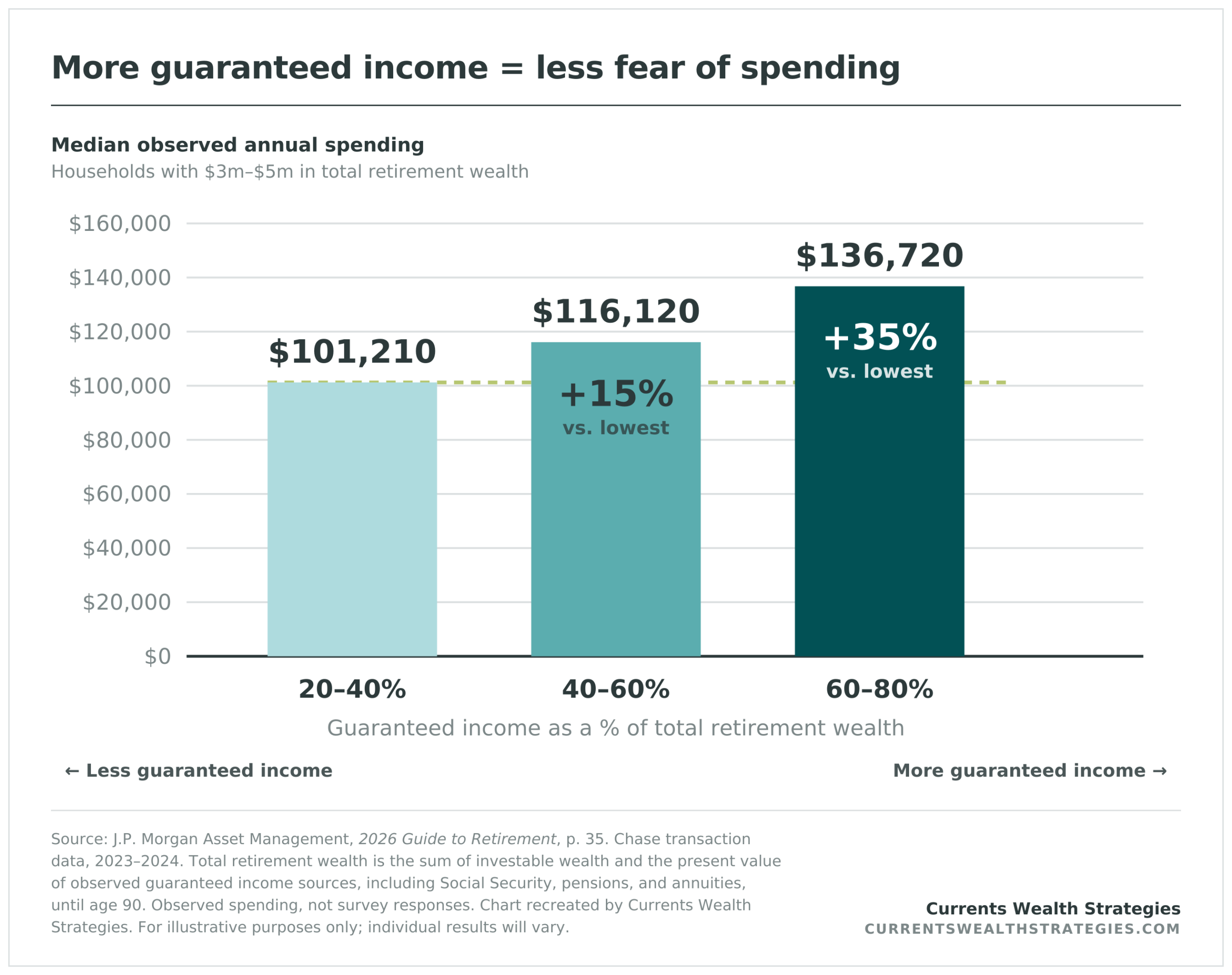
Same money. A third more spending.
Why? Confidence. After building investment balances over an entire working life, it’s genuinely hard to watch them go down. But, when you see where your retirement “paycheck” is coming from, you spend it.
This trend also shows up in another JP Morgan study looking at rolling thirty-year windows from 1928 to 2025. They found that a retiree drawing 4% from a balanced portfolio (60% Stocks / 40% Bonds) finished their life with LARGER investment balances that what they started with ⅔ of the time.
Decades of saving, followed by underspending and a surplus going to heirs.
It’s clear to me that this is a confidence problem. Not a math problem.
Here’s three solutions to help you avoid this underspending trend:
1 – Give yourself a paycheck
“If you build it, they will come.” – Field of Dreams inspired, CURRENTS approved
Be the answer that YOU need – build a retirement paycheck.
Maximize income sources like your pension (if by some miracle you actually have one), Social Security, annuities, and rental income.
Then layer a defined withdrawal on top of that base, arriving on a schedule, so the money hits your checking account the same way it did when you were working.
2 – Have a strategy for bad years before you’re in one
This is the issue that keeps up most people at night. What if markets don’t cooperate? What if I have to sell assets when they are down?
This is a reasonable fear. Sequence of returns risk is real. If you don’t have a smart strategy to address poor markets, you might panic at the worst possible time and injure your portfolio permanently.
At CURRENTS, we use a “Guardrails” approach to bring predictability to your retirement income. Under this approach, you set an upper and lower portfolio around your withdrawal rate, and if the portfolio drifts past one of them, a predetermined adjustment kicks in. Markets are strong, you get a raise. Markets are ugly, you trim by a set amount and you already knew that was coming.
We follow the same procedure in every market condition, which means there’s no decision to make in a panic. That’s the real benefit.
3 – Diversify
Spreading your investments across multiple areas is a rule everyone knows. There’s an old line about it that gets attributed to a few different people: diversification means always having to say you’re sorry.
Some part of a properly diversified portfolio is always “underperforming”. That’s by design. Your investments are supposed to behave differently, so that they don’t all fall apart at the same moment.
Here’s why it belongs on this list. Confidence to spend doesn’t come from expecting to be right. It comes from knowing what happens when you’re wrong. If one company or one sector has the power to end your retirement, no amount of planning will make you comfortable withdrawing from it.
Diversification won’t make you rich, but it will certainly keep you rich.
Back to Control
Your spending, your asset allocation, your income – all of these sit in a bucket of control that you are in charge of. Energy spent in this area is productive.
You don’t have to predict anything. And that’s the whole point.
Put a bow on it
Most successful families I meet have done nearly everything right, and it’s precisely because they’ve done so well that the cost of a wrong decision now makes them hesitate.
Our clients come to us because they want help getting clear on the life they’re excited to live, and they’d rather hand off the tax planning and investment work to someone else. If that sounds like what you’re after, we’d love to meet you.
Nate Willardson, CFP® is Managing Partner of Currents Wealth Strategies in Chandler, Arizona. He spent more than a decade managing portfolios for ultra-high-net-worth families at a global private bank before founding Currents to bring that same institutional discipline to individuals and families navigating retirement, business exits, and liquidity events.
This material is for informational and educational purposes only and does not constitute investment, tax, or legal advice, or a recommendation to buy or sell any security. Named securities are used solely as illustrations and may be held in portfolios managed by third-party fund managers. Past performance is no guarantee of future results. Indices are not available for direct investment and index returns do not reflect fees or expenses. Currents Wealth Strategies LLC is a registered investment adviser.
Sources: J.P. Morgan Asset Management, 2026 Guide to Retirement; Social Security Administration.