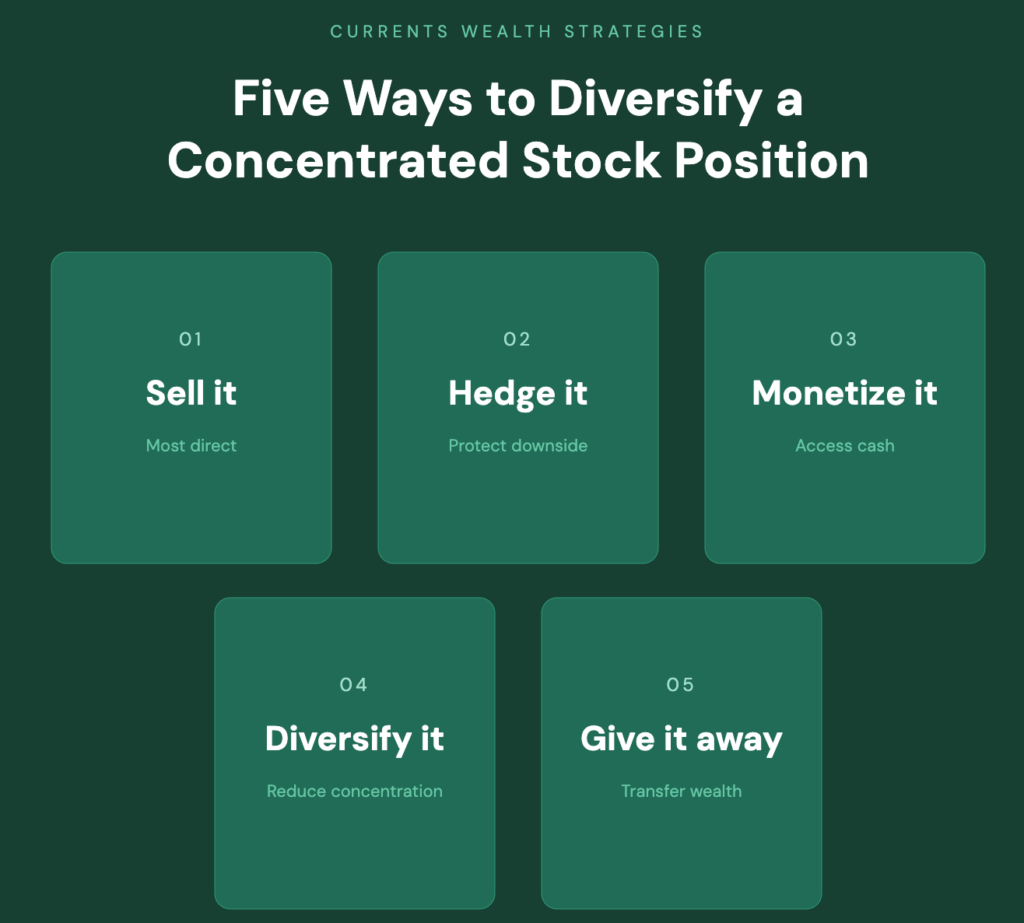
Five Ways to Diversify a Concentrated Stock Position
The short answer: You have five paths: sell it, hedge it, monetize it, diversify it, or give it away. Most clients use more than one. The right combination depends on your cost basis, your tax bracket, your timeline, and what you actually want your financial life to look like on the other side. Getting it wrong is expensive. Getting it right is one of the highest-leverage financial decisions you’ll ever make.
The Problem Nobody Talks About Enough
I’ve worked with a lot of people who built serious wealth through a single stock. An IPO, years of equity compensation, or simply being right about a company early. Congratulations, genuinely. That’s hard to do.
But here’s what 90 years of market data will tell you that most advisors won’t say out loud: the position that created your wealth is probably not the one that will protect it.
A few numbers worth sitting with:
- 96% of individual stocks underperformed the overall market over their lifetime. The entire wealth created in the U.S. stock market has been driven by just the top 4% of companies. (Bessembinder, Do Stocks Outperform Treasury Bills? Journal of Financial Economics, 2018)
- -17.8% is the median 10-year underperformance for stocks that were top performers over the prior five years. Yesterday’s winners have lagged the market 93% of the time over the following decade. (Petajisto, Underperformance of Concentrated Stock Positions, SSRN, 2023)
- 40% of Russell 3000 stocks suffered catastrophic losses of 70% or more from their peak, with most never recovering. (Cembalest, The Agony & The Ecstasy, J.P. Morgan Private Bank, updated 2024)
While I’m sure you have very high conviction in your stock (I would too), I also can’t argue with data. Outside of owning a booming business, owning large single stocks is the best way to create life changing wealth, but the real question is: how can you keep it?
That’s exactly what this article is about.
The Five Strategies: A Framework
Before we get into each one, think of this list like a salsa bar. Most people end up combining a few to get the job done. Just know that this particular menu gets habanero-level complex pretty quickly. Enjoy!
1. Sell It (Most Direct)
What it is: Converting your concentrated position into cash and reinvesting into a diversified portfolio.
How it works: Shares are sold at market price. Capital gains tax is triggered on the difference between your cost basis and the sale price. A staged selling plan, spreading sales across multiple tax years, can keep gains within lower brackets. Executives subject to trading windows may use a Rule 10b5-1 plan to sell on a pre-set schedule, removing the emotion and the compliance headache simultaneously.
Best for: Investors who prioritize risk reduction over tax deferral, or those who’ve run the math and determined that paying the tax and diversifying produces a better long-term outcome than continued concentration. (Spoiler: the math often supports this more than people expect. The underperformance compounds. The tax does not.)
Key trade-off: You pay the capital gains tax now. But consider what you’re buying: the ability to sleep at night knowing your net worth isn’t riding on one company’s next earnings call.
2. Hedge It (Protect Downside Without Selling)
What it is: Using options strategies to create a defined floor on your losses while staying invested.
How it works: A protective put gives you the right to sell your shares at a set price, typically 10-20% below current market, before expiration. Think of it as insurance on your position. You hope you never need it, but it’s there if you do. A cashless collar combines a protective put with a covered call, selling upside to fund downside protection, often at little or no net premium cost.
Best for: Investors who want to stay invested and retain upside potential, but need a defined floor. Particularly useful in the 12-24 months before a planned exit.
Key trade-off: The premium is a real cost. If the stock rises or stays flat, it’s lost entirely. Collars eliminate the premium cost but cap your upside. You’re trading a ceiling for a floor.
| Strategy | Downside Protection | Upside Retained | Premium Cost |
|---|---|---|---|
| Protective Put | Yes, full floor | Yes, unlimited | Yes, paid upfront |
| Cashless Collar | Yes, full floor | Capped at strike | Near zero |
| No hedge | None | Unlimited | None |
3. Monetize It (Access Cash Without Selling)
What it is: Borrowing against your position to generate liquidity without triggering a taxable event.
How it works: A securities-based line of credit (SBLOC) lets you borrow against your concentrated position, typically 50-70% of market value, as a revolving credit line. You pay interest only on what you draw. The position stays invested. No sale, no capital gains, no tax event.
Best for: Investors who need liquidity for a near-term goal (home purchase, business investment, bridge financing) but aren’t ready to trigger a taxable event. Also useful as a bridge while a longer-term diversification plan is being built.
Key trade-off: This adds leverage to an already concentrated position. If the stock declines significantly, you may face a margin call and be forced to repay the loan or sell shares at the worst possible time. Use it as a short-term tool, not a long-term solution.
4. Diversify It (Reduce Concentration, Tax-Efficiently)
“It is better to be roughly right than precisely wrong.” — John Maynard Keynes
Exchange Fund
What it is: You contribute your concentrated shares into a pooled fund alongside other investors with concentrated positions. You receive a diversified interest in the fund with no sale and no capital gains triggered at contribution.
How it works: Your shares are pooled with positions from other investors, creating instant diversification. After a mandatory seven-year holding period, you receive a basket of diversified stocks. Your original cost basis carries over, and taxes are deferred until you sell.
Best for: Investors with a large, low-basis position who want broad diversification without an immediate tax bill. Most powerful when an outright sale would trigger a substantial capital gains event. Minimum investment is typically $1M+.
Key trade-off: Capital is locked for seven years. Tax is deferred, not eliminated.
Direct Indexing
What it is: A separately managed account that owns individual securities replicating a broad index. Losses harvested from that portfolio offset gains as you sell your concentrated position over time.
How it works: At CURRENTS, we set a capital gains budget each year, defining exactly how much of the concentrated position to sell while staying within your target tax bracket. As individual stocks in the direct indexing account decline, losses are harvested and applied against those gains. You know exactly what the tax bill looks like before anything moves.
Best for: Investors with a planned exit timeline who want a structured, tax-aware, predictable selling plan.
Key trade-off: Loss harvesting takes time to build. It reduces the tax bill on exit but doesn’t eliminate it.
Long/Short Overlay
The turbo version of direct indexing. An active manager goes long on stocks expected to outperform and short on stocks expected to decline, generating harvestable losses on both sides of the portfolio, in both rising and falling markets. More complex, more expensive, but potentially more powerful for large positions that need an accelerated exit. The long/short approach has been around for a long time, but has recently seen massive traction in the wealth management world. Before going down this path, know the risks involved. It’s not as simple as it sounds. Remember, a little habanero is great for a salsa. Too much, and you could get burned.
5. Give It Away (Transfer Wealth With Tax Benefits)
If you have charitable intent, and many of the clients I work with do, this is one of the most powerful tools in the kit.
Donor-Advised Fund (DAF)
You contribute appreciated shares directly to a DAF. The DAF sells the stock, pays zero capital gains tax, and invests the proceeds. You receive an immediate deduction at full fair market value in the year of contribution. You then recommend grants to any qualified charity on your own timeline.
| Sell Then Donate Cash | Donate Shares to DAF | |
|---|---|---|
| Capital gains tax | Yes | None |
| Charitable deduction | Cash donated | Full fair market value |
| Timing flexibility | Immediate | Grant on your schedule |
Charitable Remainder Trust (CRT)
A CRT holds your concentrated stock, sells it tax-free, and pays you an income stream, typically 5-8% of trust value annually, for life or a set term. At the end, remaining assets pass to your chosen charity. You receive a partial charitable deduction at funding. The income stream distributes the gain gradually rather than triggering it all at once.
Best for: Charitably inclined investors who want to convert a low-basis position into reliable income while eliminating the immediate capital gains hit.
How to Actually Choose
As with anything in finance, “it depends.” But it really does in this instance. Start with your cost basis, your tax bracket, and what percentage of your overall portfolio this position actually represents.
If this position needs to fund a goal, protect it or start an exit. Don’t let taxes be the reason you stay exposed. Taxes are the price you pay because you won. Congrats!
If you’d like professional advice to help you tackle your concentrated stock, please reach out to CURRENTS or your qualified financial professional.
Frequently Asked Questions
What counts as a “concentrated” stock position? The general rule of thumb is that if more than 10-20% of your investable net worth sits in a single stock, you have meaningful concentration risk. I’ve seen clients come in with 85-90% in one position, which is where the risk becomes existential, not theoretical.
Do I have to pay capital gains tax when I diversify? Not necessarily and not all at once. Strategies like exchange funds, direct indexing, charitable giving through a DAF, and SBLOCs are specifically designed to defer, reduce, or eliminate the capital gains tax triggered by diversification. The right combination depends on your situation.
What’s the difference between a protective put and a collar? A protective put gives you a downside floor while keeping all your upside, but you pay a premium for that protection. A collar sells your upside above a certain price to fund the downside protection, resulting in near-zero net cost. You’re trading a ceiling for a floor.
When is the right time to start planning? Before you think you need to. The most powerful strategies (exchange funds, direct indexing, CRTs) all take time to build or have holding period requirements. Clients who start planning 2-3 years before a planned exit have dramatically more options than those who start 60 days before.
Can I use more than one strategy at the same time? Yes, and most clients with large positions do. A common approach: sell a portion of the position each year into a direct indexing account, using harvested losses to offset the gains. We set a capital gains budget at the start of each year so there are no tax surprises. The full exit might take 3-5 years, but the tax bill is manageable the whole way through. For clients who are charitably inclined, we’ll also direct a portion of the appreciated stock into a donor-advised fund. It’s more tax efficient to donate the stock directly than to sell it, pay the gains, and then write a check.
Strategy descriptions are for educational purposes only. Every strategy involves trade-offs and tax, legal, and compliance implications that vary by individual circumstance. This material does not constitute investment, tax, or legal advice. Consult qualified advisors before implementing any strategy. Currents Wealth Strategies LLC is a registered investment adviser.
Nate Willardson, CFP® is the founder of CURRENTS Wealth Strategies, a fee-only, fiduciary financial planning firm in Chandler, AZ. After nearly a decade advising ultra-high-net-worth families at a global private bank, he built CURRENTS to deliver that same level of advice without the institutional constraints. He specializes in concentrated equity, business exits, and retirement transition planning.