I’ve lived the same moment many times over in my career. A potential client sits in my office with a $3 million portfolio. About ten minutes in, they ask THE question: “How are you going to produce enough income for us to live on?”
After I probe a bit to learn more, 99% of the time, what they are ACTUALLY asking is: how can I live off the income my portfolio throws off, and never touch a dollar of principal?
I call this “Investing Valhalla”. It’s a mythical promised land where every stock goes up, taxes don’t exist, and your principal stays untouched forever.
The road to Valhalla almost always starts with dividend stocks, but eventually includes covered calls or infinite banking…
Here’s how I honestly think about dividends, and how I tackle the question in real life.
First, I like dividend stocks
I really do. Companies that pay steady, growing dividends tend to have stable cash flows. They’re usually reasonably priced, often blue-chip companies with mature businesses. You’re paying a fair price for steady, consistent growth, with income coming to you along the way. And most dividends are qualified, which means they’re taxed at long-term capital gains rates instead of the ordinary income rates you’d pay on bond interest, for example.
For someone living off of their portfolio, there’s a behavioral perk too. Dividends arrive every quarter and it sort of feels like a paycheck coming in.
The problem I see most is when the focus on investing in dividend stocks becomes so myopic that it becomes the only thing someone wants to own. They ignore the basics of good portfolio construction, like diversification.
Three problems with the dividend-only plan
1. The math is tighter than people expect. Here’s what $3 million produces in annual income, before taxes, at current yields as of November 2026:
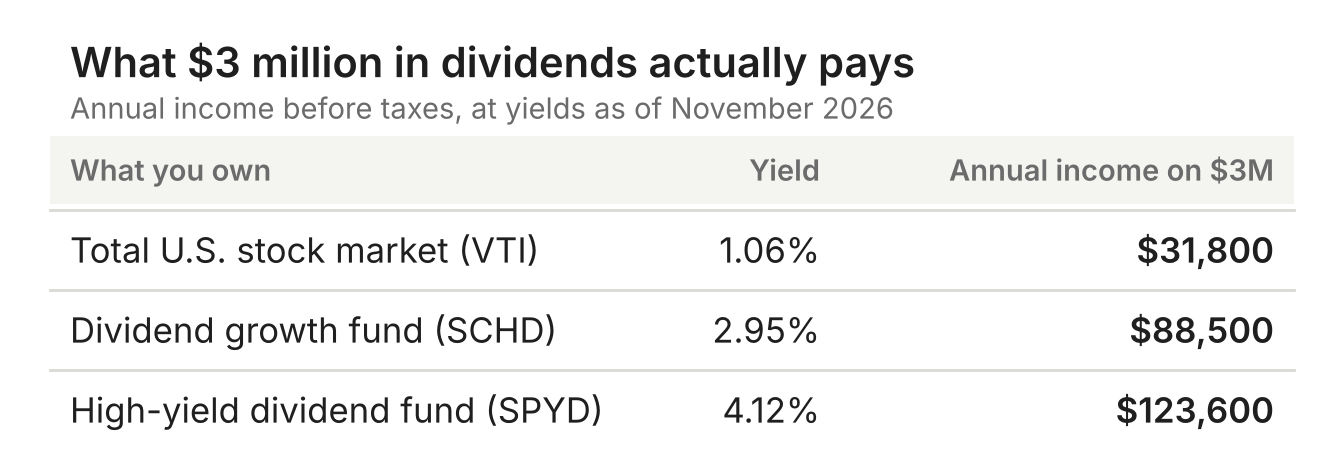
A family that spends $150,000 a year would need roughly $5 million in SCHD to cover it from dividends alone, or about $14 million in VTI. The only way to squeeze more income out of $3 million is to reach for higher yield. That’s where the next two problems show up.
2. Dividends aren’t free money. When a company pays a dividend, its share price typically drops by about the same amount. A $100 stock that pays a $2 dividend is now worth something closer to $98. You didn’t make $2. You moved $2 from one pocket to the other.
And you’ll owe taxes on it. A dividend is taxable the year it’s paid, whether you needed the cash or not. Even if it’s reinvested into the same stock or fund, it’s still taxable. For higher earners, the 15% or 20% qualified dividend rate may also carry an extra 3.8% net investment income tax on top.
3. The Velvet Rope of Volatility. This is the belief that a market crash will politely skip over your stocks because they pay a quarterly check. It won’t.
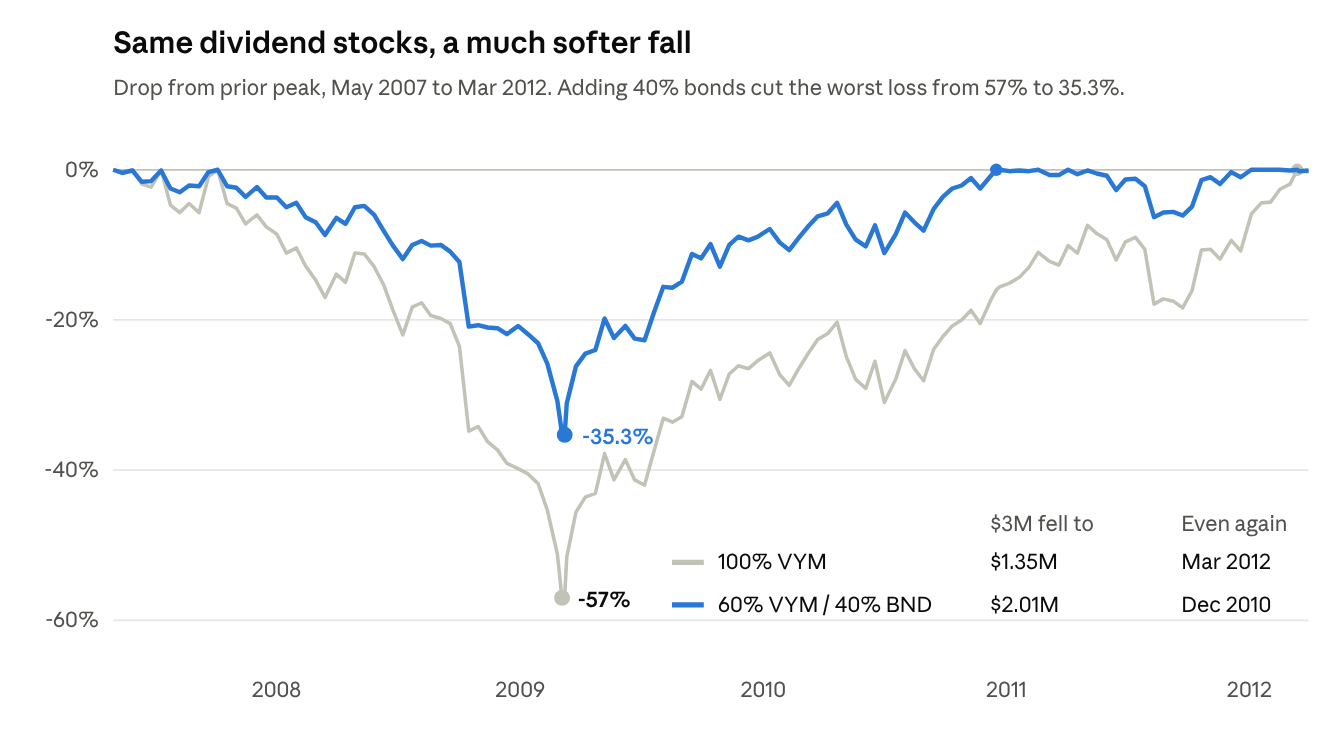
From late 2007 to early 2009, the Vanguard High Dividend Yield fund (VYM) fell -57%. The total stock market fell -55%. The fund literally built for dividend income lost slightly more than the market, and it took about four and a half years to get back to even.
Dividends can also get cut in a crash: S&P 500 dividends per share fell 21% from 2008 to 2009, and they didn’t get back to their old level until 2012.
A $3 million VYM portfolio invested in mid-2007 bottomed out at about $1.35 million. That’s a hard storm to weather in an early retirement scenario. A more balanced mix of 60% VYM and 40% bonds (BND) fell only 35% instead, bottoming out around $2 million. The ride was much smoother too, with about 40% less volatility.
Look, nothing fancy here. Same dividend stocks, just paired with something that moves differently. That’s diversification, and it’s the reason the ride was so much smoother.
The better question: where should your paycheck come from?
At Currents, we think about retirement cash flow as coming from four sources: interest, dividends, capital gains, and principal. It’s a framework grounded in retirement income research,¹ and the key insight is that the four are interchangeable. You can draw from whichever makes the most sense that year.
A dollar from a dividend and a dollar from selling a share you’ve held for ten years spend exactly the same at the grocery store. The difference is that you choose when to sell and how much gain to realize. A dividend shows up on your tax return whether you wanted it or not.
A diversified total-return portfolio uses all four sources. Here’s what that looks like in practice:
- You own things that move differently. Treasuries, municipal bonds, and CDs tend to hold up when stocks fall. Preferred stock and real estate can add income too, though they don’t always escape a crash. Dividend stocks still belong in the mix. They just shouldn’t be the whole mix.
- You keep a war chest. We set aside two to three years of near-term spending in cash and high-quality bonds, and up to five years for the most conservative investors. When markets fall, that’s what you live on, so your stocks get time to recover instead of being sold at the bottom. In good years, you trim winners to refill it.
- You control the tax bill. You decide which shares to sell, which accounts to draw from, and how much income to recognize each year.
- You may get to spend more. Research suggests that an income-only approach can lead people to underspend what their portfolio could actually support. We use a guardrails approach to build a true paycheck, with clear rules for when it goes up or down. That gives you the confidence to spend the right amount instead of underspending.
As the old line goes, it’s better to be vaguely right than precisely wrong. The dividend-only plan feels precise. You know exactly what the check will be. A total-return plan with clear spending rules is less tidy, but it’s far more likely to get you where you want to go.
So, can you live off dividends alone?
With enough money and a strong stomach, yes. For most families with $3+ million, it may mean living on less than they planned, taking more risk than they want, or paying more tax than they have to.
You spent 40 years getting a paycheck. Retirement should feel the same: money shows up in your checking account every month, no matter what the market did that week. Dividends can be part of how that check gets funded. Valhalla is optional.
Nate Willardson, CFP® is Managing Partner of Currents Wealth Strategies in Chandler, Arizona. He spent more than a decade managing portfolios for ultra-high-net-worth families at a global private bank before founding Currents to bring that same institutional discipline to individuals and families navigating retirement, business exits, and liquidity events.
Sources
- Fund yields and drawdowns: issuer data (Vanguard, Schwab, State Street) and Currents analysis, total return with dividends reinvested, Nov 2006 to Nov 2026 (VYM vs. 60/40 backtest: May 2007 to Nov 2026)
- S&P 500 dividends per share by year, from Robert Shiller’s dataset and S&P Dow Jones Indices
- ¹ Kitces, “The Four Pillars of Retirement Income Portfolios”
- Kitces, “Retirement Paychecks from a Diversified Total-Return Portfolio”
This material is for informational and educational purposes only and does not constitute investment, tax, or legal advice, or a recommendation to buy or sell any security. Named securities are used solely as illustrations and may be held in portfolios managed by third-party fund managers. Past performance is no guarantee of future results. Indices are not available for direct investment and index returns do not reflect fees or expenses. Currents Wealth Strategies LLC is a registered investment adviser.
Currents Wealth Strategies LLC is a Registered Investment Adviser. Information presented is for educational purposes only and does not intend to make an offer or solicitation for the sale or purchase of any specific securities, investments, or investment strategies. Investments involve risk and, unless otherwise stated, are not guaranteed. Be sure to first consult with a qualified financial adviser and/or tax professional before implementing any strategy discussed herein. Past performance is not indicative of future performance.